Business Asset Disposal Relief Calculator 2026/27
For a sale on or after 6 April 2026, Business Asset Disposal Relief (BADR) taxes a qualifying gain at a flat 18%, where it would otherwise be taxed at 18% or 24% depending on your income.1 It covers up to £1,000,000 of gains over your lifetime,2 falling to £500,000 for disposals on or after 6 April 2027 under Budget 2026.3 Because 18% is now the same as the lower CGT rate, BADR only saves tax on gain that would otherwise be taxed at 24%: the saving is 6p in every £1 of it. Enter your figures below to see the bill with and without the relief.
CGT with BADR: £44,460. Without it: £59,263.80. The relief saves you £14,803.80.
| Lifetime limit for this sale date | £1,000,000 |
| Limit left after earlier claims | £1,000,000 |
| Gain that gets BADR | £250,000 |
| Annual exempt amount used (£3,000 in all) | £0 on other gains, £3,000 on the BADR gain |
| Basic rate band left after your income | £270 |
| BADR gain at 18% | £247,000 → £44,460 |
| Total CGT | £44,460 |
| Lifetime limit left after this sale | £750,000 |
| Deadline to claim the relief | 31 January 2029 |
Uses the 2026/27 Personal Allowance of £12,570 (reduced by £1 for every £2 of income over £100,000) and the £37,700 basic rate band. Scottish taxpayers use the same UK bands for CGT. It does not check whether you qualify; see the conditions below.
The order HMRC works it out in
Three rules decide the bill, and they are why a plain "gain × 18%" can be wrong.4
- The lifetime limit comes first. Only gains up to what is left of your limit get BADR. Anything above it is an ordinary gain at 18% or 24%. Earlier claims under the old name, Entrepreneurs' Relief, count towards the limit.2
- The £3,000 allowance goes where it saves most. HMRC allocates it in the most beneficial way, against gains taxed at the highest rate first, so it goes against gains that could be taxed at 24% before the BADR gain.5
- BADR gains fill the basic rate band first. A BADR gain uses up whatever is left of your £37,700 basic rate band before any other gain does. So a basic-rate taxpayer selling a business and some shares in the same year pays 24% on the shares, not 18%.4
Four examples, worked by this calculator
| Seller | With BADR | Without | Saving |
|---|---|---|---|
| Company sale, £60,000 salary: £400,000 gain | £71,460 | £95,280 | £23,820 |
| Same sale after 6 April 2027, £200,000 used before: £400,000 gain | £77,280 | £95,280 | £18,000 |
| Basic-rate seller, £30,000 income: £80,000 gain | £13,860 | £17,263.80 | £3,403.80 |
| Basic-rate seller with £20,000 of share gains too: £50,000 gain + £20,000 other | £13,080 | £14,863.80 | £1,783.80 |
In the first example, a £60,000 salary already uses the whole basic rate band, so without the relief all £397,000 of taxable gain would be at 24%. With BADR it is all at 18%: £71,460, a saving of £23,820.
The second is the same sale after 6 April 2027, by someone who claimed BADR on £200,000 of gains before. The limit is then £500,000, leaving £300,000; the other £100,000 is taxed at 24%, so the bill rises to £77,280.
The third shows why the relief is worth less to a basic-rate taxpayer. £30,000 of income leaves £20,270 of the basic rate band, and that part of the gain would have been at 18% anyway. BADR only changes the rest, saving £3,403.80.
The fourth adds £20,000 of share gains. The £3,000 allowance goes against the shares, but the £50,000 BADR gain fills the £20,270 band, so the remaining £17,000 of share gains is taxed at 24%. The relief still saves £1,783.80, less than 6% of the business gain.
Do you qualify?
The calculator assumes the gain qualifies. GOV.UK sets out the main conditions:1
- Selling all or part of a business as a sole trader or partner: you owned the business for at least 2 years up to the sale.
- Selling shares: for at least 2 years you were an employee or office holder of the company, its main activities were trading, and (unless the shares came from an EMI scheme) you held at least 5% of the shares and voting rights and were entitled to at least 5% of profits and assets.
- Assets you let the business use: you also sold at least 5% of your share of the partnership or company, and the business used the assets for at least one year.
The trading test, dilution below 5% and the other qualifying assets are covered in our BADR guide, and the wider sale in CGT when selling a business.
Before or after 6 April 2027?
Budget 2026 cuts the lifetime limit from £1,000,000 to £500,000 for disposals on or after 6 April 2027. This is announced and still needs the Finance Bill 2026-27, and there will be special rules for contracts made before 6 April 2027 that complete later.3 The rate stays at 18%. For a gain of £1,000,000 or more by someone with no earlier claims, the lower limit moves £500,000 from 18% to 24%: up to £30,000 more tax. Switch the tax year in the calculator to compare. Founders with a large stake may also want to read about the proposed Founders' Relief.
How to claim
You claim BADR on your Self Assessment return, or with the form on GOV.UK if you do not file one, by 31 January in the second year after the tax year of the sale: for a 2026/27 sale that is 31 January 2029.2 Your share of a UK property sale still needs a 60-day return if there is tax to pay; see the reporting deadlines. For gains that do not qualify, use the main CGT calculator.
Frequently asked questions
How much tax do I pay with Business Asset Disposal Relief?
18% on qualifying gains for disposals on or after 6 April 2026, up to your lifetime limit. It was 14% in 2025/26 and 10% before 6 April 2025. Gains above the limit are taxed at 18% or 24% depending on your income.
Is BADR worth claiming now the rate is 18%?
Yes if any of the gain would otherwise be taxed at 24%. The saving is 6% of that part of the gain. For a basic-rate taxpayer, the part of the gain that fits in the unused basic rate band would have been taxed at 18% anyway, so the saving is smaller.
Does the £3,000 allowance come off the BADR gain?
Only if you have no other gains taxed at a higher rate. HMRC allocates the annual exempt amount in the most beneficial way, against gains taxed at the highest rate first, so it goes against ordinary gains before the BADR gain.
Why does BADR push my other gains into the 24% rate?
The law sets BADR gains against your unused basic rate band before any other gains (TCGA 1992 section 1I). If the BADR gain fills the band, your other gains in the same year are taxed at 24%.
What is the BADR lifetime limit?
£1 million of qualifying gains for disposals on or after 11 March 2020. Budget 2026 announced a cut to £500,000 for disposals on or after 6 April 2027, subject to the Finance Bill 2026-27, with special rules for contracts made before that date. Earlier Entrepreneurs' Relief claims count towards the limit.
An estimate for UK residents, not tax advice. It does not check the qualifying conditions, apply losses you choose to set elsewhere, or model Investors' Relief or the proposed Founders' Relief.
Before you go
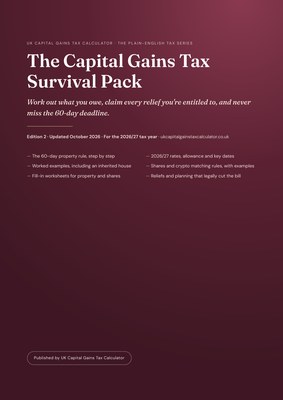
Capital Gains Tax Survival Pack
- The 60-day property deadline, step by step
- Share and crypto matching rules, with worksheets
£4.99 one-off · instant download · full refund via our contact page
Sources & references
The rates, allowances and rules in this guide are drawn from the official HMRC and GOV.UK sources below, checked for the 2026/27 tax year. Each link opens the relevant government page in a new tab.
- Business Asset Disposal Relief www.gov.uk/business-asset-disposal-relief
- Business Asset Disposal Relief: how to claim www.gov.uk/business-asset-disposal-relief/how-to-claim
- Budget 2026: Overview of tax legislation and rates (OOTLAR) www.gov.uk/government/publications/budget-2026-overview-of-tax-legislation-and-rates-ootlar/budget-2026-overview-of-tax-legislation-and-rates-ootlar
- Taxation of Chargeable Gains Act 1992, section 1I: entrepreneur gains use the basic rate band first www.legislation.gov.uk/ukpga/1992/12/section/1I
- Business Asset Disposal Relief (Self Assessment helpsheet HS275) www.gov.uk/government/publications/entrepreneurs-relief-hs275-self-assessment-helpsheet