Business Asset Rollover Relief: How It Works, With a Calculator
If you sell a business asset at a gain and put the money into new qualifying assets for the same trade, you can postpone the Capital Gains Tax until you sell the new asset.1 The new assets must be bought within 3 years after the sale or up to one year before it.1 Reinvest everything and the whole gain is deferred; reinvest less and the gain taxed now is the lower of the whole gain and the money you kept back.2 The deferred gain is knocked off the cost of the new asset, so it is taxed later rather than never.
- Qualifying classes include land, buildings, fixed plant or machinery and goodwill. Old and new assets need not be the same type.2
- Window: one year before to 3 years after the disposal.1
- Partial reinvestment: taxed now = the lower of the gain and the proceeds not reinvested.2
- Depreciating assets (fixed plant or machinery, or a life of 60 years or less) hold the gain over for up to 10 years instead.2
- Claim on the HS290 form with your return, code ROR, within 4 years of the end of the later tax year.12
Rollover relief calculator
Enter what you sold the old asset for, the gain you worked out on it, and what the new qualifying assets cost. If the old asset was only partly used in your trade, enter the trading share. We work out the gain deferred, the gain taxed now and the 2026/27 tax on it. What you type is sent with the form and not put in the page address.
| Gain rolled over | £70,000 |
| Gain taxed now | £50,000 |
| CGT now for 2026/27 (no other gains) | £11,280 |
| CGT without the relief | £28,080 |
| Cost of the new asset for its own future sale | £280,000 |
To defer all of the qualifying gain you would need to spend at least £400,000 on new assets. Tax after the £3,000 allowance, at 18% in the basic rate band left by your income and 24% above.3 Estimates, not tax advice; Business Asset Disposal Relief is not modelled.
What rollover relief does, in plain terms
Traders often sell one property to buy a bigger one, or swap a yard for a unit nearer their customers. Without relief, the gain on the old asset would be taxed even though the money went straight back into the business. Rollover relief postpones that tax: HMRC's guidance says you will not pay any tax until you sell the new asset.1
It does this by moving the gain rather than cancelling it. The deferred gain is deducted from the cost of the new assets,2 so when you eventually sell them your gain is bigger by the same amount. If you keep rolling from one asset to the next, the tax keeps moving forward with you.
Worked example 1: everything reinvested
A shop owner sells premises for £75,000, making a gain of £15,000, and buys a new shop for £90,000. Every pound of the proceeds has gone into the new shop, so the whole gain can be rolled over.
| Gain rolled over | £15,000 |
| Gain taxed now | £0 |
| Cost of the new shop for a later sale: £90,000 less the rolled-over gain | £75,000 |
| Tax this owner would otherwise pay now (£55,000 income) | £2,880 |
Worked example 2: keeping some of the money back
HMRC's helpsheet uses the same sale with a cheaper replacement: a shop sold for £75,000 with a gain of £15,000, and a new shop bought for £70,000.2 The owner kept £5,000 of the proceeds. The gain taxed now is the lower of the whole gain (£15,000) and the amount not reinvested (£5,000).
| Proceeds not reinvested | £5,000 |
| Gain taxed now | £5,000 |
| Gain rolled over | £10,000 |
| Cost of the new shop: £70,000 less the rolled-over gain | £60,000 |
| CGT now for 2026/27 | £480 |
The first £3,000 of the £5,000 is covered by the £3,000 allowance; the other £2,000 is taxed at 24% for a higher-rate taxpayer. Notice the trap in the rule: the test is about proceeds, not the gain. If this owner had spent only £60,000, the £15,000 kept back would equal the whole gain and nothing could be rolled over.
Worked example 3: a shop with a flat above it
Relief only reaches the part of an asset used in the trade. HMRC's example is a building with a shop and a flat above, sold for £160,000 with a gain of £80,000, where three-quarters relates to the shop.2 Only the shop's share of the gain (£60,000) can be rolled over, and only the shop's share of the proceeds (£120,000) needs reinvesting to defer all of it.
| Qualifying gain (75%) | £60,000 |
| Gain rolled over | £60,000 |
| Gain on the flat, taxed now | £20,000 |
| CGT now for 2026/27 | £4,080 |
The same restriction applies by time. HS290's example 4 is a shop owned for 10 years but used in the trade for only 5: half the £20,000 gain can be deferred, and the owner needs to reinvest £50,000, half of the £100,000 proceeds.2 Use the trading share box in the calculator for either kind of split.
Which assets qualify
The old and new assets must each fall into one of the qualifying classes, but they do not have to be in the same class. The main ones are interests in land, interests in buildings or parts of buildings, fixed plant or machinery, and goodwill; ships, aircraft and certain quotas and entitlements are also listed.2 So you can sell a building and roll the gain into goodwill, or the other way round.
Both assets must be used in your trade. HMRC accepts the new asset being used in a different trade that you start shortly after the first one ends, with a gap of up to 3 years between the two.2 Shares are not a qualifying class, which is why selling your company is a matter for Business Asset Disposal Relief, not rollover relief.
Depreciating assets: held over, not rolled over
A depreciating asset is fixed plant or machinery, or any asset with a maximum life expectancy of 60 years or less.2 A lease with under 60 years to run is a common example. If the new asset is one of these, the gain is not deducted from its cost. Instead it is frozen and comes back into charge at the earliest of three events: you dispose of the new asset, you stop using it in the trade, or 10 years pass from when you bought it.2
| Gain held over | £50,000 |
| Cost of the machinery (not reduced) | £220,000 |
| When the gain comes back | Sale, end of trade use, or 10 years |
Tick the depreciating asset box in the calculator to see the figures this way. The held-over gain is charged in the year the triggering event happens, at the rates and allowance for that year.
Selling before you have found the replacement
You do not have to wait. You can claim provisional relief by declaring that you intend to reinvest the proceeds.2 GOV.UK says the provisional claim can run for up to 3 years from the 31 January after the tax year of the disposal, and you then claim again once you have bought the new asset.1 If you declare an intention and do not go on to claim, the deferred tax becomes payable with interest.2 HS290's example 17 puts dates on it: an asset sold in June 2025 with a £20,000 gain, tax deferred past 31 January 2027, and the declaration running out on 31 January 2029 if no claim follows.2
How to claim
- Complete the claim form in helpsheet HS290 and send it with your Self Assessment return. If you cannot, post it to Capital Gains Tax Queries, HM Revenue and Customs, BX9 1AS.1
- Enter the code ROR in box 8 or box 20 of the capital gains pages, or MUL if more than one code applies.2
- Claim within 4 years of the end of the tax year in which you bought the new asset, or sold the old one if that was later.1 HS290's example: a shop sold in May 2023 and replaced in August 2025 must be claimed by 5 April 2030.2
Keep the completion statements for both assets, evidence of trade use, and your working for the gain. For the gain itself, our allowable costs guide lists what you can deduct, and CGT on selling a business covers the reliefs that apply when the whole business goes.
Market value sales and compulsory purchase
If you sell to a family member for less than the asset is worth, the gain is worked out using market value, and so is the reinvestment test. HS290's example 15 is a shop worth £80,000 sold to a son for £10,000: the gain is £30,000, some relief needs new assets costing more than £50,000, and full relief needs £80,000.2 The helpsheet also covers a let house compulsorily purchased by a local authority, where reinvesting the £150,000 compensation in another let house defers the gain.2
Frequently asked questions
How long do I have to reinvest for rollover relief?
You must buy the new assets within 3 years of selling or disposing of the old ones, or up to one year before.
What if I reinvest only part of the proceeds?
The gain taxed now is the lower of the whole gain and the part of the proceeds you did not reinvest. The rest of the gain is deferred and comes off the cost of the new asset.
Which assets qualify?
The main classes are land, buildings, fixed plant or machinery and goodwill, plus ships, aircraft and some other assets. The old and new assets do not have to be the same type, but both must be used in your trade.
What is different about depreciating assets?
Fixed plant or machinery, and any asset expected to last 60 years or less, do not take the deferred gain off their cost. The gain is held over until the earliest of selling the new asset, stopping using it in your trade, or 10 years from buying it.
How do I claim rollover relief?
Use the claim form in helpsheet HS290 with your Self Assessment return, and the code ROR on the capital gains pages. The claim must be made within 4 years of the end of the tax year in which you bought the new asset or sold the old one, if later.
General information for UK residents, not tax advice. Figures for 2026/27 disposals.
Before you go
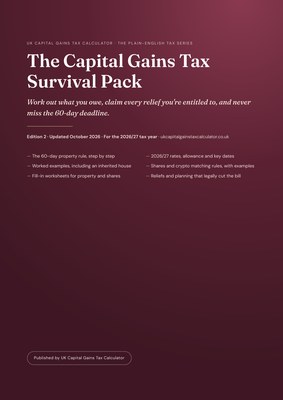
Capital Gains Tax Survival Pack
- The 60-day property deadline, step by step
- Share and crypto matching rules, with worksheets
£4.99 one-off · instant download · full refund via our contact page
Sources & references
The rates, allowances and rules in this guide are drawn from the official HMRC and GOV.UK sources below, checked for the 2026/27 tax year. Each link opens the relevant government page in a new tab.
- Business Asset Rollover Relief www.gov.uk/business-asset-rollover-relief
- HS290 Business Asset Roll-over Relief (2026) (checked 27 Nov 2026) www.gov.uk/government/publications/business-asset-roll-over-relief-hs290-self-assessment-helpsheet/hs290-business-asset-roll-over-relief-2026
- Capital Gains Tax: rates and the £3,000 allowance for 2026 to 2027 (checked 22 Nov 2026) www.gov.uk/capital-gains-tax/rates