Capital Gains Tax on Shares Bought or Sold in a Foreign Currency
Work out the gain in pounds, not in dollars or euros. Your cost is the sterling value of what you paid, at the exchange rate on the day you bought; your proceeds are the sterling value of what you received, at the rate on the day you sold.1 The exchange rate movement in between is part of your gain or loss, so a share that did nothing in dollars can still show a sterling gain or loss. HMRC does not insist on a particular source of rates, but expects a reasonable method used consistently.1
- Cost: sterling equivalent at the rate on the acquisition date. Proceeds: sterling equivalent at the rate on the disposal date.1
- Any reasonable, consistent source of exchange rates is acceptable to HMRC.1
- For individuals, a foreign currency bank account does not produce chargeable gains or allowable losses (since 6 April 2012).2
- The sterling gain is taxed like any other: £3,000 allowance, then 18% within the basic rate band and 24% above.3
- Same-day, 30-day and section 104 matching apply to foreign shares exactly as to UK shares.4
Foreign currency gain calculator
Enter the amounts in the currency you dealt in, and each day's rate as currency units per £1 (for example 1.27 dollars to the pound). We convert each figure on its own date and work out the 2026/27 tax. Nothing you type is put in the page address.
| Cost in pounds (price and fees at 1.25) | £16,008 |
| Proceeds in pounds, less fees (at 1.35) | £19,251.85 |
| Sterling gain | £3,243.85 |
| Gain in the currency, converted at the sale rate (the common mistake) | £4,429.63 |
| Capital Gains Tax for 2026/27 if this is your only gain | £58.52 |
The exchange rate movement took off £1,185.78 compared with converting the currency gain at the end. Tax after the £3,000 allowance, at 18% in the basic rate band left by your income and 24% above.3 One disposal, no losses brought forward. Estimates, not tax advice.
Why the exchange rate is part of your gain
UK tax is charged in pounds, so a disposal of foreign shares is treated as two sterling figures. HMRC's Capital Gains Manual describes a purchase paid in dollars as costing the sterling equivalent of the dollars at the exchange rate in force on the date of acquisition, and a later sale for euros as bringing in the sterling equivalent of the euros at the rate in force on the date of disposal.1 The gain is the difference between those two sterling figures, less the costs of buying and selling.
That means the exchange rate on two different days is built into the answer. If the pound weakens while you hold the shares, the same dollar proceeds buy more pounds and your sterling gain is bigger. If the pound strengthens, the sterling gain is smaller and can turn into a loss.
Worked example 1: no dollar gain, but a sterling loss
You buy shares for $10,000 when the pound buys $1.25, and sell them for exactly $10,000 when it buys $1.35. In dollars nothing happened.
| Cost: $10,000 ÷ 1.25 | £8,000 |
| Proceeds: $10,000 ÷ 1.35 | £7,407.41 |
| Sterling loss | £592.59 |
The loss is real for UK tax. Report it and it can be set against other gains in the same year, or carried forward. A broker statement in dollars would show no gain at all, which is why the dollar figures cannot go straight onto a UK return.
Worked example 2: the same dollar gain, two very different sterling gains
Two investors each pay $20,000 plus $10 commission and sell for $26,000 less $10. Each makes $5,980 in dollars. One bought when the pound was at $1.35 and sold at $1.25; the other bought at $1.25 and sold at $1.45. Both have £55,000 of other income.
| Pound weakened | Pound strengthened | |
|---|---|---|
| Cost in pounds, with fees | £14,822.22 | £16,008 |
| Proceeds in pounds, less fees | £20,792 | £17,924.13 |
| Sterling gain | £5,969.78 | £1,916.13 |
| Dollar gain converted at the sale rate | £4,784 | £4,124.14 |
| CGT after the £3,000 allowance | £712.75 | £0 |
The first investor's sterling gain is £1,185.78 more than the shortcut suggests, and the whole excess over £3,000 is taxed at 24%.3 The second investor's gain falls inside the allowance, so there is no tax at all, although the shortcut would have shown £4,124.14 of gain. Using the shortcut overstates one bill and understates the other.
Fees, dividends reinvested and other costs
Commission and other dealing costs are part of the cost or come off the proceeds, so convert them on the same basis as the price: buying costs at the purchase-day rate, selling costs at the sale-day rate. That is what the calculator does. If your broker charges a currency conversion spread, it is already inside the rate on your contract note; use the rate the broker actually applied if it shows one, and keep using the same approach for every trade.
Withholding tax deducted from foreign dividends is an income tax matter, not part of the share's cost for CGT. This page deals only with the gain when you sell.
Which exchange rate to use
HMRC's manual says it does not prescribe what reference point should be used for the exchange rate, but expects a reasonable and consistent method.1 In practice the cleanest evidence is the rate on your broker's contract note for each trade, because that is the rate at which the currency actually changed hands. If your broker does not show one, a published daily rate for the trade date is a reasonable alternative. What you should not do is pick whichever source gives the lower gain trade by trade.
Pooling several purchases made in dollars
Foreign shares follow the same identification rules as UK shares: a sale is matched first with shares bought the same day, then with shares bought in the next 30 days, then with the section 104 pool.4 Each purchase goes into the pool at its own sterling cost, using the rate on the day it was bought. A pool of US shares bought monthly over five years therefore has sixty exchange rates inside it, and the sale is converted at one more.
Our share pool tracker does the matching and keeps a running pool. If your broker gives you a CSV in dollars, add one column, fx_rate, with the dollars per £1 on each trade date, and import the file: the tracker converts each line's amount and fees to pounds at that line's rate before pooling. The file is read in your browser and nothing is uploaded.
| Line | What it says |
|---|---|
holding,date,type,shares,amount,fees,fx_rate | Header row |
Acme Inc,2024-03-01,BUY,100,10000,10,1.25 | Cost £8,000 plus £8 fees |
Acme Inc,2026-06-01,SELL,100,12000,10,1.35 | Proceeds £8,888.89 less £7.41 fees |
What about the dollars you keep after selling?
Currency is itself an asset for CGT. When you sell shares for euros, HMRC treats the euros as acquired at the sterling value of the shares on that day, so if you later change them into pounds at a better rate you could have a further gain.1 For most private investors the cash sits in an account, though, and for individuals a foreign currency bank account is treated as a simple debt that does not give rise to chargeable gains or allowable losses, from 6 April 2012.2 So the exchange movement on dollars left in a currency bank account after a sale is outside CGT; check how your broker holds the cash if you are unsure whether it is a bank account.
Records to keep for each trade
- The contract note: date, number of shares, price, commission and currency.
- The exchange rate you used for that date, and where it came from.
- Any share split, consolidation or bonus issue, which changes the number of shares but not the sterling cost.
- Your sterling working: the converted cost, proceeds and fees, so the figures on your return can be traced back.
Gains and losses on shares go on the capital gains pages of your Self Assessment return; our guide to CGT on shares covers the reporting thresholds and the boxes, and CGT losses explains how a sterling loss like example 1 is used.
Frequently asked questions
Which exchange rate do I use for capital gains tax on US shares?
The rate on each date: the purchase date for the cost and the sale date for the proceeds. HMRC does not prescribe a particular source of rates, but expects a reasonable method used consistently.
Can I work out the gain in dollars and convert it at the end?
No. Converting the dollar gain at the sale-date rate ignores the change in the exchange rate since you bought, which is part of your sterling gain or loss. Convert the cost and the proceeds separately.
Can I have a capital gain even if the shares fell in dollars?
Yes. If the pound weakened enough between the purchase and the sale, the sterling proceeds can be higher than the sterling cost even though the dollar price fell. The reverse also happens.
Is there tax on the dollars I keep in my account after the sale?
For individuals, a foreign currency bank account is treated as a simple debt and does not give rise to chargeable gains or allowable losses, from 6 April 2012. Currency held in another form follows the general rules, where the currency is an asset acquired at the sterling value on the day you received it.
How do I pool shares I bought in dollars at different times?
Convert each purchase to sterling at the rate on its own date and add the sterling cost to the section 104 pool. The same-day and 30-day rules apply exactly as for UK shares. Our share pool tracker can import a broker file with an fx_rate column and convert each line for you.
General information for UK residents, not tax advice. Figures for 2026/27 disposals.
Before you go
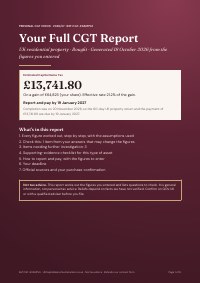
Your Full CGT Report
- Every 2026/27 figure worked out from your own numbers
- Your deadline, and what to report and when
£4.99 one-off · instant download · full refund via our contact page
Sources & references
The rates, allowances and rules in this guide are drawn from the official HMRC and GOV.UK sources below, checked for the 2026/27 tax year. Each link opens the relevant government page in a new tab.
- HMRC Capital Gains Manual CG78310: assets acquired or sold for foreign currency (checked 22 Nov 2026) www.gov.uk/hmrc-internal-manuals/capital-gains-manual/cg78310
- HMRC Capital Gains Manual CG78320: foreign currency bank accounts (checked 22 Nov 2026) www.gov.uk/hmrc-internal-manuals/capital-gains-manual/cg78320
- Capital Gains Tax: rates and the £3,000 allowance for 2026 to 2027 (checked 22 Nov 2026) www.gov.uk/capital-gains-tax/rates
- Shares and Capital Gains Tax (Helpsheet HS284) www.gov.uk/government/publications/shares-and-capital-gains-tax-hs284-self-assessment-helpsheet