EIS and SEIS: Deferring or Cutting Capital Gains Tax on a Gain
Two different reliefs hide behind the same acronyms. Put money from a gain into new Enterprise Investment Scheme shares and you can postpone the tax on that gain: it comes back when you sell the EIS shares or another trigger happens.2 Put it into Seed Enterprise Investment Scheme shares instead and up to half of the gain becomes exempt for good, capped at £100,000 of relief.3 EIS shares must be issued between one year before and three years after your disposal;2 SEIS reinvestment relief also needs you to get SEIS Income Tax relief on the same shares.3
- EIS: Income Tax relief at 30%, annual limit £1 million (£2 million if at least £1 million goes into knowledge-intensive companies).1
- SEIS: Income Tax relief at 50% on up to £200,000 a year.1
- EIS deferral: any gain on any asset can be deferred; you may claim less than the maximum to use your £3,000 allowance.2
- SEIS reinvestment: 50% of the gain exempt, limited to half the amount invested, maximum £100,000.3
- Gains on the EIS or SEIS shares themselves are exempt after 3 years if the Income Tax relief was given and not withdrawn.1
EIS and SEIS relief calculator
Enter the gain you want to shelter, how much you are subscribing, and which scheme. For EIS we defer as much as the investment allows while leaving £3,000 in charge for your allowance, as HMRC's own example does. For SEIS we apply the 50% rules. The form is posted to our server; nothing goes into the page address.
| Gain before relief | £60,000 |
| Gain deferred into EIS shares | £50,000 |
| Gain left in charge this year | £10,000 |
| CGT for 2026/27 without the relief | £13,680 |
| CGT for 2026/27 with the relief | £1,680 |
| Income Tax relief on the subscription (at most, if you have that much Income Tax to reduce) | £15,000 |
The £12,000 is postponed, not cancelled: the deferred gain is charged when a revival event happens. Deferring everything above the allowance would need a subscription of £57,000. Tax after the £3,000 allowance at 18% and 24%.4 Estimates only: the company must actually qualify, and the Income Tax relief depends on your own tax bill.
Deferral or exemption: which one is on offer?
People often talk about "rolling a gain into EIS" and "SEIS reinvestment" as if they were the same thing with different limits. They work in opposite ways.
| EIS deferral relief | SEIS reinvestment relief | |
|---|---|---|
| What happens to the gain | Postponed until a revival event2 | Up to half treated as exempt3 |
| How much can be sheltered | Up to the amount subscribed2 | 50% of the gain or 50% of the investment, whichever is lower, maximum £100,0003 |
| Timing | Shares issued from one year before to three years after the disposal2 | Gain and SEIS investment in the same tax year, per HS3933 |
| Paperwork | EIS3 certificate from the company2 | SEIS3 certificate from the company3 |
So EIS is a timing tool: useful if you expect to pay tax at a lower rate later, or never to trigger the gain while you are alive. SEIS is a genuine reduction, but the companies are very small and the amounts are capped.
Worked example: HMRC's £100,000 gain into EIS
HS297's example 5 is an investor with a £100,000 gain who subscribes £100,000 for EIS shares. Rather than deferring the whole gain, they claim £97,000, leaving £3,000 in charge to be covered by the annual exempt amount.2 Here is that choice run through our engine for someone with £55,000 of other income:
| Gain deferred | £97,000 |
| Gain left in charge | £3,000 |
| CGT this year | £0 |
| CGT if no claim were made | £23,280 |
Claiming the full £100,000 would have wasted the allowance this year and pushed £3,000 more into the deferred gain that comes back later. Leaving exactly the allowance in charge is the usual move.
Worked example: investing less than the gain
A £60,000 gain and a £30,000 EIS subscription. Full deferral needs an investment at least equal to the chargeable gain,2 so only part can be sheltered.
| Gain deferred | £30,000 |
| Gain taxed now | £30,000 |
| CGT now / without relief | £6,480 / £13,680 |
| EIS Income Tax relief at 30%, if you have enough Income Tax | £9,000 |
What brings a deferred EIS gain back?
HS297 lists three revival events: you dispose of the EIS shares; you stop being UK resident within three years of the shares being issued; or the shares stop being, or are treated as stopping being, eligible shares.2 The GOV.UK investor page adds that the shares being cancelled or repaid, or the company ceasing to meet the conditions, also make the deferred tax payable.1
Two details matter when it happens. First, the gain is charged in the year of the revival, and you can set that year's annual exempt amount against it.2 Second, selling only some of the shares revives a proportion of the gain: in HS297's example 8, selling 15,000 of 20,000 shares brings back three-quarters of a £20,000 deferred gain, so £15,000.2
SEIS: half the gain, permanently
Reinvestment relief lets you treat up to 50% of a gain as exempt when you reinvest in SEIS shares on which you also get SEIS Income Tax relief.3 If you put in less than the gain, the relief is limited to half of what you invested. Because the most SEIS Income Tax relief anyone can claim is on £200,000, the most reinvestment relief anyone can claim is £100,000.3
HS393's example 1 shows the arithmetic plainly: a £15,000 gain and a £14,000 subscription give reinvestment relief of £7,000 (half of £14,000), leaving £8,000 chargeable.3 Our version below uses a £40,000 gain and £30,000 invested, for a higher-rate and a basic-rate taxpayer.
| £55,000 income | £35,000 income | |
|---|---|---|
| Gain made exempt | £15,000 | £15,000 |
| Gain left in charge | £25,000 | £25,000 |
| CGT with relief | £5,280 | £4,363.80 |
| CGT without relief | £8,880 | £7,963.80 |
| SEIS Income Tax relief at 50%, at most | £15,000 | £15,000 |
The basic-rate taxpayer saves less because part of their gain would have fallen in the 18% band anyway. HS393 also notes that shares issued in the following tax year can be treated as issued in the earlier one for both Income Tax relief and reinvestment relief, if you hold a valid SEIS3 for them.3
If the Income Tax relief is later withdrawn or reduced, the notes on form SEIS3 explain when that happens; check them before relying on the exemption.3
Selling the EIS or SEIS shares themselves
Separately from what they do for an earlier gain, the shares have their own exemption. You pay no CGT when you sell them if you received Income Tax relief that was not later reduced or withdrawn, and you held them for the minimum period, which is at least three years.1 For SEIS, HS393 says a sale within three years of issue gets no disposal relief and the gain is chargeable.3
Losses still count. HS297 says that when you work out a loss you must reduce the cost of the shares by any Income Tax relief given and not withdrawn. Its example 1: £100,000 subscribed with £30,000 of relief, then sold for £60,000 after £18,000 of the relief was withdrawn. The cost becomes £88,000 and the allowable loss is £28,000.2 You can choose to set an EIS loss, less any Income Tax relief already given, against your income.1 Our guide to capital losses covers using a loss against gains instead, and how to claim a capital loss sets out the four-year time limit.
Venture Capital Trusts are different again
A VCT is a listed fund, not a single company. There is no CGT relief on the money you put in, so it cannot shelter an earlier gain. Profits when you sell VCT shares are free of CGT, whether you bought new shares or second-hand ones, but there is no loss relief.1 HMRC's helpsheet HS298 covers VCTs; our helpsheets index lists it with the others.
Claiming, and the deadlines
- EIS deferral. You cannot claim until the company has sent you form EIS3. The latest date is 5 years after the first 31 January following the tax year in which the shares were issued. HS297's example: a disposal in May 2023 with shares issued in August 2024 can be claimed until 31 January 2031.2
- SEIS reinvestment. You need form SEIS3 first. For the 2025 to 2026 year, HS393 gives the latest claim date as 31 January 2032.3
- Timing the investment. For EIS, the shares must be issued in the window from one year before to three years after the disposal. HS297's example 4: a disposal on 6 June 2022 allows shares issued from 6 June 2021 to 6 June 2025.2
Because the company issues the certificate, the claim often lands after the return for the year of the gain has been filed. Keep the certificate with your records, and see our reporting guide for where the gain itself goes on the return.
Frequently asked questions
Does investing in EIS shares cancel my capital gain?
No. EIS deferral relief postpones the gain. It comes back into charge when you dispose of the EIS shares, if you become non-resident within three years of the shares being issued, or if the shares stop being eligible shares.
How long do I have to invest in EIS after selling an asset?
The EIS shares must be issued in the period from one year before to three years after the disposal that made the gain.
How much of a gain can SEIS make tax-free?
Reinvestment relief makes up to 50% of the gain exempt, with a maximum relief of £100,000. If you invest less than the gain, the relief is limited to half of the amount invested. You must also get SEIS Income Tax relief on the same shares.
Can I defer only part of my gain into EIS?
Yes. You can claim less than the maximum, for example to leave enough of the gain in charge to use your £3,000 annual exempt amount.
Are EIS and SEIS shares free of CGT when I sell them?
Gains on the shares themselves are exempt if you received the Income Tax relief, it was not withdrawn, and you held the shares for at least three years. That is separate from deferral or reinvestment relief on an earlier gain.
General information for UK residents, not tax or investment advice. EIS and SEIS companies are high risk. Figures for 2026/27 disposals.
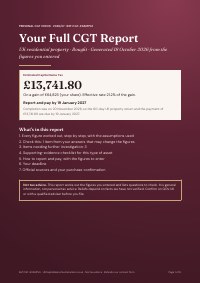
Before you go
Your Full CGT Report
- Every 2026/27 figure worked out from your own numbers
- Your deadline, and what to report and when
£4.99 one-off · instant download · full refund via our contact page
Sources & references
The rates, allowances and rules in this guide are drawn from the official HMRC and GOV.UK sources below, checked for the 2026/27 tax year. Each link opens the relevant government page in a new tab.
- Tax relief for investors using venture capital schemes (checked 27 Nov 2026) www.gov.uk/guidance/venture-capital-schemes-tax-relief-for-investors
- HS297 Capital Gains Tax and Enterprise Investment Scheme (2026) (checked 27 Nov 2026) www.gov.uk/government/publications/enterprise-investment-scheme-and-capital-gains-tax-hs297-self-assessment-helpsheet/hs297-capital-gains-tax-and-enterprise-investment-scheme-2026
- HS393 Seed Enterprise Investment Scheme: Income Tax and Capital Gains Tax reliefs (2026) (checked 27 Nov 2026) www.gov.uk/government/publications/seed-enterprise-investment-scheme-income-tax-and-capital-gains-tax-reliefs-hs393-self-assessment-helpsheet/hs393-seed-enterprise-investment-scheme-income-tax-and-capital-gains-tax-reliefs-2026
- Capital Gains Tax: rates and the £3,000 allowance for 2026 to 2027 (checked 22 Nov 2026) www.gov.uk/capital-gains-tax/rates