Capital Gains Tax on Accumulation Units: Don't Pay Twice on Reinvested Income
An accumulation unit keeps the income it earns and reinvests it, so you receive no cash and no new units; the value of the units you hold goes up instead. HMRC calls that reinvested income a "notional distribution".1 Outside an ISA or pension you pay Income Tax on it each year, and because you have, HMRC lets you add it to the cost of your units when you sell.12 Leave it out and part of your gain is taxed twice. Any equalisation payment you received in the first period works the other way: it is a return of part of the price you paid, so it comes off your cost.3
- Units in a unit trust, shares in an OEIC and shares in an investment trust follow the normal share rules, including the section 104 pool.1
- Notional distributions subject to Income Tax count as extra allowable expenditure on the units.1
- The same treatment applies to UK and non-UK resident trusts.2
- Equalisation is not income and is deducted from the price paid.3
- Reporting offshore funds: excess reported income can be deducted when you work out the gain.4
- Gains are taxed at 18% and 24% after the £3,000 annual exempt amount.5
Accumulation units calculator
Enter what you paid for the units, the total of the notional distributions you were taxed on while you held them, any equalisation shown on your first tax voucher, what you sold for and your income. We show the gain and the 2026/27 tax with the reinvested income added to your cost and without it. Inputs are posted, not shown in the address.
| Allowable cost: price + notional distributions - equalisation | £23,600 |
| Gain (or loss) | £6,400 |
| CGT for 2026/27 | £816 |
| Gain if the reinvested income is left out | £10,000 |
| CGT if it is left out | £1,680 |
| Tax overpaid by leaving it out | £864 |
One holding, sold in full, as the only disposal of the year, with the £3,000 allowance available. For a part sale, the pool cost (including the notional distributions) is shared out by the fraction of units sold.1 Estimates, not tax advice.
Income units and accumulation units: what is different
Most UK funds come in two flavours. An income unit pays its dividends or interest out to you, usually into your platform cash account. An accumulation unit pays nothing out: the income stays inside the fund and is used to buy more of the fund's investments, so each accumulation unit becomes worth more than its income twin. HMRC's helpsheet describes it in exactly those terms: the income is "retained and reinvested automatically for you", you do not receive any new units, "but the value of your existing units is increased".1
For Income Tax, the difference does not help you. The reinvested amount is still your income for the year, and outside an ISA or pension it goes on your return in the same way a paid-out dividend or interest distribution would. Your platform's annual tax certificate shows it, usually in a column headed accumulation, reinvested or notional income.
For Capital Gains Tax, the difference matters a great deal, because the increase in the unit price that comes from reinvested income would otherwise be counted as part of your gain when you sell. The rule that fixes this is short. HMRC's manual says the notional distribution "is treated as allowable expenditure where it is subject to Income Tax in the hands of the unit holder", and that this applies to both UK resident and non-UK resident trusts.2
Worked example: a fund held for five years
A higher-rate taxpayer with £55,000 of salary paid £20,000 for accumulation units in a UK equity fund. Over the years they held them, their tax certificates showed £3,600 of reinvested dividends in total, all of it included on their returns. They sell the whole holding in 2026/27 for £30,000 after dealing costs.
| Step | With the notional distributions | Leaving them out |
|---|---|---|
| Allowable cost | £23,600 | £20,000 |
| Gain | £6,400 | £10,000 |
| Less the annual exempt amount | £3,000 | £3,000 |
| CGT at 24% | £816 | £1,680 |
Getting the cost right saves £864. A basic-rate taxpayer on £35,000 with the same fund would pay £612 rather than £1,260, because the whole taxable gain fits in the unused basic rate band and is charged at 18%.5 The longer a fund is held and the higher its yield, the larger the sum that would otherwise be taxed twice.
How the notional distributions fit the share pool
Units in a unit trust, and shares in an OEIC or an investment trust, are treated as if they were shares in an ordinary company.1 That means every purchase of the same class of the same fund goes into one section 104 pool, with a single running total of cost. A notional distribution is added to that running total when it arises, without adding any units. When you sell part of the holding, the cost that goes with the units sold is the pool cost multiplied by the number sold divided by the number in the pool.1 Our section 104 pool guide shows the arithmetic, and the share pool calculator keeps the running pool for you if you enter each purchase.
One practical point follows. The same-day and 30-day rules still come before the pool: units bought on the day of a sale, or in the 30 days after it, are matched with that sale first.1 The 30-day rule guide covers that order.
Equalisation: the one adjustment that goes the other way
When you buy into a fund part way through a distribution period, the price you pay includes the income the fund has already earned in that period. At the end of the period every unit gets the same distribution, so you would be paid back income that you in effect bought. The fund deals with this by showing part of your first distribution as "equalisation".
HMRC's manual is clear about what it is. It "is not income", it should not be treated as a capital distribution, and "it is a return of the initial price paid and it should therefore be deducted from the price paid when computing the chargeable gain on the eventual disposal".3 You will usually see the figure only on the tax voucher for the first period after each purchase. It is small, but if you are already gathering the notional distributions it costs nothing to take it off as well.
Taking a fund that cost £12,000, with £900 of taxed notional distributions and £60 of equalisation, sold for £15,500: the allowable cost is £12,840, the gain is £2,660, and that sits inside the £3,000 allowance, so the CGT is £0. Without the adjustments the gain would be £3,500 and a higher-rate taxpayer would pay £120.
Offshore accumulation classes and excess reported income
Many funds sold on UK platforms, including most exchange-traded funds, are domiciled in Ireland or Luxembourg. For UK tax these are offshore funds, and each share class is treated as a separate fund.4 An accumulating class of a reporting offshore fund does not issue tax vouchers in the UK style. Instead it publishes an annual report of reportable income per unit; the part not paid out is "excess reported income", and UK investors are taxed on their full share of reportable income "even if it has not been distributed".4
The capital gains result is the same idea as the notional distribution rule. HS265 says excess reported income which arose while you owned the units "can be deducted when calculating your capital gain", so that you are not taxed twice.4 In the calculator above, put the total excess reported income you were taxed on in the notional distributions box. Excess reported income is treated as received six months after the end of the fund's reporting period, which is often a different tax year from the one the income was earned in.4
If the class is a non-reporting fund, the rules are different and much less favourable: the gain is taxed as income. Our offshore funds guide explains how to check status and what it does to the bill.
Records to keep, fund by fund
- Contract notes for every purchase and sale, with dealing charges, which form part of the cost or reduce the proceeds.
- Every annual tax certificate or tax voucher showing the notional distribution for each class you hold outside an ISA.
- The equalisation figure from the first voucher after each purchase.
- For offshore classes, each year's reportable income report and the number of units you held at the end of the reporting period.4
- A note of when each notional distribution was included on your return, so you can show it was subject to Income Tax.2
Platforms may show a "book cost" figure that may or may not include reinvested income, and a figure that has been carried over from a platform transfer may have lost the history. Check the book cost against your own totals before you rely on it. If you have lost the vouchers for some years, the fund manager or platform can usually reissue the distribution history.
When none of this applies
Funds held in a stocks and shares ISA or a pension are outside both Income Tax and CGT, so nothing is reported and there is no cost to adjust; see CGT and ISAs. A switch between sub-funds of an umbrella scheme is normally a disposal of the old units, while a switch as part of a merger of sub-funds may not be.1 Moving units between platforms without selling is not a disposal at all, but it is the moment cost records most often go missing, so download the full history before the transfer.
Once the gain is worked out, the rest follows the normal rules: report it through Self Assessment if your gains are over the allowance or your total proceeds are high enough to need reporting (see do I need to report CGT), and pay by 31 January after the end of the tax year.
Frequently asked questions
Can I add reinvested dividends from accumulation units to my CGT cost?
Yes, where they were subject to Income Tax. HMRC's helpsheet HS284 says that if you receive notional distributions which are subject to Income Tax, you are allowed the amount of those distributions as additional expenditure on your accumulation units.
What is a notional distribution?
Income that an accumulation unit would have paid out but which is kept and reinvested in the fund instead. You get no new units; the value of the units you already hold goes up.
What do I do with an equalisation payment?
Deduct it from the price you paid. HMRC's manual CG57705 says it is a return of part of the price you paid, not income, so it reduces your allowable cost when you work out the gain.
Does this apply to funds held in an ISA?
No. Gains and income inside an ISA are free of tax, so there is nothing to add back and nothing to report.
Where do I find my notional distribution figures?
On the tax vouchers or annual consolidated tax certificates your platform or fund manager sends each year. Keep every year's figures for every fund you hold outside an ISA.
General information for UK residents, not tax advice. Figures for 2026/27 disposals.
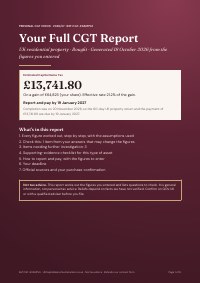
Before you go
Your Full CGT Report
- Every 2026/27 figure worked out from your own numbers
- Your deadline, and what to report and when
£4.99 one-off · instant download · full refund via our contact page
Sources & references
The rates, allowances and rules in this guide are drawn from the official HMRC and GOV.UK sources below, checked for the 2026/27 tax year. Each link opens the relevant government page in a new tab.
- HS284 Shares and Capital Gains Tax (2026), sections 5 and 6: unit trusts and accumulation units (checked 29 Nov 2026) www.gov.uk/government/publications/shares-and-capital-gains-tax-hs284-self-assessment-helpsheet/hs284-shares-and-capital-gains-tax-2026
- HMRC Capital Gains Manual CG57707: unit trusts, accumulation units (checked 29 Nov 2026) www.gov.uk/hmrc-internal-manuals/capital-gains-manual/cg57707
- HMRC Capital Gains Manual CG57705: unit trusts, dividend equalisation payments (checked 29 Nov 2026) www.gov.uk/hmrc-internal-manuals/capital-gains-manual/cg57705
- HS265 Offshore funds (updated 6 April 2026) (checked 29 Nov 2026) www.gov.uk/government/publications/offshore-funds-self-assessment-helpsheet-hs265/hs265-offshore-funds
- Capital Gains Tax: rates (18% and 24% from 6 April 2026, £3,000 allowance for 2026 to 2027) (checked 29 Nov 2026) www.gov.uk/capital-gains-tax/rates