Offshore Funds and Capital Gains Tax: Why Reporting Status Decides the Bill
An Irish or Luxembourg ETF, a SICAV or an ICAV held outside an ISA or pension is usually an "offshore fund" for UK tax. If the share class you hold is a reporting fund for the whole time you own it, a gain on selling is a capital gain, taxed at 18% or 24% after the £3,000 allowance, and you can deduct the excess reported income you have already paid Income Tax on.13 If it is a non-reporting fund, the gain is normally an "offshore income gain" and is charged to Income Tax instead, at up to 45%.1 Check the class on HMRC's list of reporting funds before you buy, and certainly before you sell.2
- Each sub-fund, and each class of interest in it, is treated as a separate offshore fund.1
- HMRC publishes the list of approved reporting funds on GOV.UK and updates it every month.2
- Reporting fund: Income Tax on reportable income each year, CGT on the gain at the end.3
- Non-reporting fund: Income Tax on distributions, and Income Tax on the gain as an offshore income gain.14
- A loss on a non-reporting fund counts as nil for the income charge and can only be used as a capital loss.6
- Holdings inside an ISA: nothing to declare.1
Reporting v non-reporting calculator
Enter what you paid, what you sold for, any excess reported income you were taxed on while you held the fund, the fund's status and your Income Tax rate. We work out the CGT if the class is a reporting fund and the Income Tax on an offshore income gain if it is not, side by side, for 2026/27. Inputs are posted, not shown in the address.
| Reporting fund | Non-reporting fund | |
|---|---|---|
| Amount charged | £18,500 capital gain | £20,000 offshore income gain |
| Tax | £3,720 CGT | £8,000 Income Tax at 40% |
| Your fund (reporting) | £3,720 | |
The reporting column deducts the excess reported income and the £3,000 allowance and uses your income to split the gain between 18% and 24%.7 The non-reporting column charges the whole gain at the Income Tax rate you pick; a large gain can cross into a higher band, so the true figure may be higher. A fund that was non-reporting for any part of your ownership can still produce an offshore income gain.4 Estimates, not tax advice.
What counts as an offshore fund
The UK has its own tax regime for UK investors in offshore funds, and "offshore fund" has a specific meaning. Broadly, it is an investment fund based outside the UK that meets certain conditions.1 HMRC's helpsheet gives examples of non-UK funds that can be offshore funds: non-UK unit trusts such as Jersey or Guernsey property unit trusts, non-UK corporate funds such as a SICAV or an Irish ICAV, and co-ownership arrangements such as an FCP or a common contractual fund. A non-UK partnership fund is not an offshore fund.1
The unit that matters is smaller than the fund. Where a fund is an umbrella with several sub-funds, each sub-fund is a separate offshore fund, and where a sub-fund has more than one class of interest, each class is treated as a separate offshore fund.1 That is why one ETF range can have a sterling-hedged accumulating class with reporting status and a US dollar distributing class without it. UK OEICs and UK investment trusts are based in the UK rather than offshore, so they follow the ordinary share rules in our CGT on shares guide.
How to check reporting status
A reporting fund is one that has applied to HMRC, been approved and keeps its status.1 HMRC publishes the list of approved reporting funds as a spreadsheet on GOV.UK, updated every month, with each fund's reporting fund reference, name, sub-fund reference and ISIN.2 Search the spreadsheet by the ISIN of the exact class you hold, not by the fund's name, and check that the entry covers the whole time you have held it. The fund manager can also tell you whether the fund has applied to HMRC to become a reporting fund.1
Status has to cover the whole period you held the units. HMRC's manual says the charge on an offshore income gain generally arises where the fund is non-reporting, "or is one that, at any time during the period when the interest has been held, had been a non-reporting fund".4 If the class gained reporting status after you bought it, read the transitional rules in the Investment Funds Manual or take advice before selling.
Reporting funds: Income Tax every year, CGT at the end
A reporting fund must report its income to HMRC and to its UK investors for each reporting period. The figure is given per unit; you multiply it by the units you held at the end of the period.1 UK investors are taxed on their full share "even if it has not been distributed", and the part not paid out is the excess reported income.1 HMRC's overview puts it the same way: you return both the distributions and your share of the undistributed excess, and you pay Income Tax on the total.3
How the income is taxed depends on the fund. A corporate fund with more than 60% of its investments in interest-bearing assets is a "bond fund" and its income is reported as interest; other corporate funds pay dividends; transparent funds keep the character of the underlying income; non-transparent unit trusts produce miscellaneous income. All of it goes on the Foreign pages (SA106).1 Excess reported income is treated as received on the fund distribution date, six months after the end of the reporting period. A period ending on 31 July 2024 gives a fund distribution date of 31 January 2025, so the income belongs to 2024/25.1
When you sell, the gain is a capital gain, and any excess reported income that arose while you owned the units "can be deducted when calculating your capital gain".1 The deduction works like the notional distribution rule for UK accumulation units, explained in our accumulation units guide.
Non-reporting funds: the gain is taxed as income
A non-reporting fund has not obtained reporting status, or has left the regime. It does not report its income, so there is no excess reported income and you are taxed only on what is actually paid out.1 The cost comes at the end. If you dispose of units in a non-reporting fund, any gain "will normally be treated as an 'offshore income gain'", and you "will be subject to Income Tax, rather than Capital Gains Tax" on it.1
The gain itself is worked out as if it were a capital gain. HMRC's manual says the offshore income gain equals the "basic gain", the amount that would be the gain on that disposal for the purposes of the Taxation of Chargeable Gains Act 1992.5 Because it is income, though, none of the CGT features that cut the bill apply to it: not the £3,000 annual exempt amount, not the 18% and 24% rates. The amount charged to Income Tax is then deducted from your proceeds for the CGT computation, which in most cases leaves no capital gain at all.4 The offshore income gain goes on page 6 of the Foreign pages, "Other overseas income and gains".1
Worked example: the same sale, two statuses
An investor with £55,000 of salary bought units for £40,000 and sells them in 2026/27 for £60,000. If the class was a reporting fund, they will have paid Income Tax on £1,500 of excess reported income over the years.
| Status | Amount taxed | Tax on the sale |
|---|---|---|
| Reporting fund, higher-rate taxpayer | £18,500 gain | £3,720 CGT |
| Non-reporting fund, 40% Income Tax | £20,000 offshore income gain | £8,000 |
| Non-reporting fund, 45% Income Tax | £20,000 | £9,000 |
| Non-reporting fund, basic-rate taxpayer on £35,000 at 20% | £20,000 | £4,000 (CGT if reporting: £2,803.80) |
For the higher-rate taxpayer, non-reporting status costs £4,280 on this one sale. In the basic-rate row, a £20,000 offshore income gain on top of £35,000 of income would in reality cross into the 40% band, so the 20% figure understates the tax; it is shown only to compare like with like.
Losses work against you too
If a non-reporting fund is sold at a loss, the basic gain is treated as nil for the offshore income gain rules, so "no loss is to be treated as arising" under them. Any loss can be relieved only as a capital loss, and HMRC's manual adds that "the capital loss cannot be offset against offshore income gains of the same or of a later period".6 In other words, a loss on one non-reporting fund does not shelter a gain on another; it can only reduce capital gains, such as gains on shares or reporting funds. Taking the example above, a sale at £32,000 instead gives an offshore income gain of £0 and a capital loss of £8,000, to be claimed in the usual way within four years (see how to claim a capital loss).
Practical steps before you sell
- Find the ISIN of each class you hold outside an ISA or pension and look it up in HMRC's reporting funds list.2
- Gather the annual reportable income reports for every period you held a reporting class; multiply the excess per unit by your units at each period end.1
- If a report has not arrived by the filing date, HS265 says to include your best estimate and amend later.1
- For a non-reporting class, work out the gain in sterling as a normal capital gain and enter it on SA106 page 6 as an offshore income gain.1
- If the fund was bought or sold in another currency, convert each side at the rate on its own date; see shares bought in dollars or euros.
If you hold offshore funds through an ISA, HS265 says you do not need to declare the income or gains from them.1 Holding a non-reporting fund inside an ISA removes the problem entirely, which is one reason to check status before choosing which account to buy a fund in. Investors who arrived in the UK recently should also look at HS266, which HS265 points to for the foreign income and gains regime for qualifying new residents.1
Frequently asked questions
How do I know if my offshore fund has reporting status?
Check HMRC's list of approved offshore reporting funds on GOV.UK, which is updated every month, or ask the fund manager. Status is decided for each sub-fund and each share class separately, so check the exact class you hold.
What happens if I sell a non-reporting fund at a gain?
The gain is normally an offshore income gain. You pay Income Tax on it rather than Capital Gains Tax, so the 18% and 24% CGT rates and the £3,000 allowance do not apply to it. It goes on page 6 of the Foreign pages (SA106).
What is excess reported income?
The part of a reporting fund's reportable income that is not paid out to you. You pay Income Tax on it each year, and you can deduct it when you work out your capital gain on selling, so it is not taxed twice.
Can I use a capital loss against an offshore income gain?
No. HMRC's manual says a capital loss cannot be set against offshore income gains of the same or a later period. A loss on a non-reporting fund counts as nil for the income charge and can only be used as a capital loss.
Do I need to worry about this inside an ISA?
No. HS265 says that reporting and non-reporting offshore funds can both be held in an ISA, and if your investment is held through an ISA you do not need to declare the income or gains from it.
General information for UK residents, not tax advice. Figures for 2026/27 disposals.
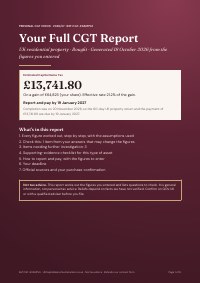
Before you go
Your Full CGT Report
- Every 2026/27 figure worked out from your own numbers
- Your deadline, and what to report and when
£4.99 one-off · instant download · full refund via our contact page
Sources & references
The rates, allowances and rules in this guide are drawn from the official HMRC and GOV.UK sources below, checked for the 2026/27 tax year. Each link opens the relevant government page in a new tab.
- HS265 Offshore funds (updated 6 April 2026) (checked 29 Nov 2026) www.gov.uk/government/publications/offshore-funds-self-assessment-helpsheet-hs265/hs265-offshore-funds
- Approved offshore reporting funds (list updated monthly; last updated 4 November 2026) (checked 29 Nov 2026) www.gov.uk/government/publications/offshore-funds-list-of-reporting-funds
- HMRC Investment Funds Manual IFM12446: overview of the treatment of UK investors (checked 29 Nov 2026) www.gov.uk/hmrc-internal-manuals/investment-funds/ifm12446
- HMRC Investment Funds Manual IFM13410: the charge to tax on disposal of an interest in a non-reporting fund (checked 29 Nov 2026) www.gov.uk/hmrc-internal-manuals/investment-funds/ifm13410
- HMRC Investment Funds Manual IFM13520: computation of offshore income gain, the basic gain (checked 29 Nov 2026) www.gov.uk/hmrc-internal-manuals/investment-funds/ifm13520
- HMRC Investment Funds Manual IFM13550: computation of offshore income gain, losses (checked 29 Nov 2026) www.gov.uk/hmrc-internal-manuals/investment-funds/ifm13550
- Capital Gains Tax: rates (18% and 24% from 6 April 2026, £3,000 allowance for 2026 to 2027) (checked 29 Nov 2026) www.gov.uk/capital-gains-tax/rates