Selling Part of Your Garden or Land: Do You Pay Capital Gains Tax?
Usually not, if the plot is part of the garden of the home you live in and you sell it while you still own the house. Private Residence Relief covers garden and grounds up to the permitted area, which is half a hectare or more if the house needs it.1 The order matters: HMRC gives no relief if you sell the garden after you have sold the home.1 Where tax is due, only part of what you paid for the whole property counts as the cost of the plot, worked out as cost × A ÷ (A + B).3
- Garden and grounds of half a hectare or less: relief for all of it. Larger: relief for the area needed for the reasonable enjoyment of the house.1
- GOV.UK's simple test for full relief includes grounds, with all buildings, under 5,000 square metres (just over an acre).2
- Land sold after the house has gone gets no Private Residence Relief.1
- Cost of the part sold = cost × A ÷ (A + B): A is the price for the plot, B the value of what you keep.3
- Small sales of land (no more than £20,000 and one-fifth of the holding) can be claimed not to be a disposal at all.4
Part disposal calculator
Enter what you paid for the whole property (with buying costs and improvements), the price for the plot, and what the house and remaining land are worth after the sale. Tick the box if the plot is garden of your main home, within the permitted area, and you still live there. Figures are posted to us for the working and never added to the page address.
| Share of the value sold: A ÷ (A + B) | 20.0% |
| Cost given to the plot | £60,000 |
| Cost left with what you keep | £240,000 |
| Gain on the plot | £56,000 |
| CGT for 2026/27 (no other gains) | £12,720 |
Tax after the £3,000 allowance, at 18% in the basic rate band left by your income and 24% above.5 Costs that relate only to the plot (such as its own planning or legal fees) belong to the plot alone; enter them as selling costs. Estimates, not tax advice.
Selling a plot from the garden of the home you live in
This is the common case: a developer or neighbour offers to buy the bottom of your garden, or you get planning permission for a house on the side plot. HS283 says you are entitled to relief if you dispose of land that you occupy as your garden or grounds, up to the permitted area, at the time of your disposal.1 Three things need to be true on the day you sell:
- the land is garden or grounds you occupy with your home, rather than a separate field or paddock you happen to own;
- you still own the home and it is still your residence;
- the garden and grounds, taken together, fall within the permitted area.
If all three hold, the gain on the plot is covered in the same way the gain on the house would be. You do not need to fill in the calculator above to know the answer is nil. You do want the cost split, though, because it fixes how much of your original price is left for the house when you eventually sell that.
How big can the garden be?
HMRC's starting figure is half a hectare. If your garden and grounds do not exceed half a hectare, you are entitled to relief for all of it; if they are bigger, you may not be.1 Above that figure the permitted area is the area required for the reasonable enjoyment of the house as a home, judged by the size and character of the house.1 A large country house may justify more land than a small cottage with the same acreage.
GOV.UK's short checklist for full relief on a home uses the same size in different units: grounds, including all buildings, of less than 5,000 square metres, or just over an acre.2 HS283's first example is a house with a garage, a granny flat, a summer house and 0.203 hectares of garden. Because the grounds are under half a hectare, even the summer house at the end of the garden still attracts relief.1
Where your land is bigger than the permitted area, the extra land is outside the relief. A plot carved from that extra land can be taxable even while you live in the house. That is the case the calculator handles with the box unticked.
The trap: selling the house first
People sometimes sell the house, keep the bottom of the garden, and get planning permission on it afterwards. HS283 is clear that there is no relief where you dispose of all or part of your garden after you have disposed of your home.1 At that point the land is no longer the garden of anyone's residence. It is just land you own, and the whole gain on it is taxable.
The fix is in the timing. If you want to sell both, selling the plot first, while the house is still your home, keeps it inside the relief.
Working out the cost of the part you sell
You bought the house and garden for one price, and you are now selling a piece. HMRC's manual splits the original cost using a fixed formula: allowable expenditure for the part disposed of equals expenditure × A ÷ (A + B), where A is what you receive for the part sold and B is the market value of the part you keep at the time of the sale.3 For land and buildings HMRC asks the Valuation Office to check the value of the retained part,3 so it is worth getting a proper valuation of what you keep rather than guessing.
The manual's own example uses round numbers. An asset cost £40,000; part of it is sold for £15,000; the part kept is worth £45,000.3
| Cost given to the part sold: £40,000 × 15,000 ÷ 60,000 | £10,000 |
| Cost carried forward to the part kept | £30,000 |
| Gain on the part sold | £5,000 |
Not every cost is split. Costs that relate only to the part you keep are not allowable at all against the part you sell, and costs that relate only to the part you sell are fully allowable against it.3 A planning application for the plot, a survey of its boundary or the legal fees on its sale belong to the plot alone.
Worked example: a building plot that is not covered
Suppose a property bought for £300,000 includes land beyond the permitted area, and a plot from that land sells for £120,000. After the sale, the house and remaining land are worth £480,000. Selling costs on the plot are £4,000, and the seller has £55,000 of other income.
| Share of value sold | 20% |
| Cost given to the plot | £60,000 |
| Gain after selling costs | £56,000 |
| CGT for 2026/27 | £12,720 |
| Cost left with the house and remaining land | £240,000 |
After the £3,000 allowance, all of this gain is taxed at 24% because the seller's income already fills the basic rate band. A residential plot is UK land, so check whether a 60-day property return is needed; our guide to reporting property gains explains when.
Very small sales: the £20,000 rule
Selling a strip of land to a neighbour for a driveway or a boundary change can create a gain that is barely worth calculating. Section 242 of the Taxation of Chargeable Gains Act 1992 lets you claim for a small transfer of land not to be treated as a disposal.4 The conditions:
- the price is no more than one-fifth of the market value of the holding;4
- the price is no more than £20,000;4
- if you made other disposals of land in the same tax year, the total for all of them is no more than £20,000.4
The tax is postponed rather than cancelled: the price is deducted from your allowable cost when you later dispose of the rest.4 The claim must be made by the first anniversary of the 31 January after the tax year of the transfer, so for a 2026/27 sale by 31 January 2029.4 It does not apply to transfers between spouses or civil partners, which give neither a gain nor a loss anyway.4
| Price as a share of the holding | 4.5% |
| Within the one-fifth and £20,000 limits? | Yes |
| Cost of what is kept after a claim (£250,000 less £18,000) | £232,000 |
| Cost of what is kept with the normal split instead | £238,750 |
If the strip is garden of your main home inside the permitted area, Private Residence Relief would cover it anyway, and the claim is not needed.
Records to keep
- The original purchase completion statement and any improvement invoices for the whole property.
- A plan showing the plot, the whole garden and its area, which is your evidence on the permitted area.
- A valuation of the part you keep at the date of sale (B in the formula).
- Invoices for costs that relate only to the plot.
For the rest of the rules on homes, see Private Residence Relief and CGT on selling a former home. If the land is a business asset and you are buying a replacement, rollover relief may also be relevant.
Frequently asked questions
Do I pay CGT if I sell part of my garden to a developer?
Not if the land is garden or grounds you occupy with your main home, it is within the permitted area, and you still own and live in the home when you sell. Private Residence Relief covers it.
What is the permitted area?
Half a hectare, or more if a larger area is required for the reasonable enjoyment of the house as a home, taking its size and character into account.
What if I sell the house first and the land later?
HMRC's helpsheet HS283 says there is no relief if you dispose of all or part of your garden after you have disposed of your home. The gain on the land is taxable.
How do I work out the cost of the part I sold?
Multiply the cost of the whole property by A divided by A plus B, where A is the price for the part sold and B is the market value of the part you keep. The rest of the cost stays with the part you keep.
Is there a rule for very small sales of land?
Yes. If the price is no more than one-fifth of the market value of the whole holding and no more than £20,000, and your land sales in the year total no more than £20,000, you can claim for it not to be treated as a disposal. The price comes off your cost instead.
General information for UK residents, not tax advice. Figures for 2026/27 disposals.
Before you go
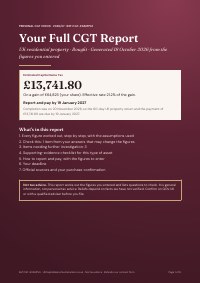
Your Full CGT Report
- Every 2026/27 figure worked out from your own numbers
- Your deadline, and what to report and when
£4.99 one-off · instant download · full refund via our contact page
Sources & references
The rates, allowances and rules in this guide are drawn from the official HMRC and GOV.UK sources below, checked for the 2026/27 tax year. Each link opens the relevant government page in a new tab.
- HS283 Private Residence Relief (2026) (checked 27 Nov 2026) www.gov.uk/government/publications/private-residence-relief-hs283-self-assessment-helpsheet/hs283-private-residence-relief-2026
- Tax when you sell your home (Private Residence Relief) www.gov.uk/tax-sell-home
- HMRC Capital Gains Manual CG12731: part disposals, allowable costs and apportionment (checked 27 Nov 2026) www.gov.uk/hmrc-internal-manuals/capital-gains-manual/cg12731
- Taxation of Chargeable Gains Act 1992, section 242: small part disposals of land (checked 27 Nov 2026) www.legislation.gov.uk/ukpga/1992/12/section/242
- Capital Gains Tax: rates and the £3,000 allowance for 2026 to 2027 (checked 22 Nov 2026) www.gov.uk/capital-gains-tax/rates