Capital Gains Tax for Trustees in 2026/27
Trustees pay Capital Gains Tax at a flat 24% on every gain, whatever the asset, for disposals on or after 30 October 2024.2 Their tax-free allowance for 2026/27 is £1,500, half the figure for individuals,3 and it is shared out when the same person has set up several trusts: each trust's allowance is divided by the number in the group, up to five.2 A trust for a disabled or otherwise vulnerable beneficiary gets £3,000.1 Bare trusts are different again: the beneficiary is taxed as if they owned the assets.2
- Rate for trustees and personal representatives: 24%. There is no 18% band.42
- Annual exempt amount: £1,500 for most trusts; £3,000 where the beneficiary is vulnerable.13
- Several trusts made by one settlor since 6 June 1978: each allowance divided by the number of trusts, counting no more than five.12
- A beneficiary becoming absolutely entitled is a deemed disposal by the trustees at market value.2
- UK residential property: report and pay within 60 days of completion. Other gains: the trust and estate tax return.1
Trustees' CGT calculator
Enter the trust's total gains for the tax year, any losses made in the same year, and how many trusts the settlor has made since 6 June 1978. Tick the box for a trust with a disabled or vulnerable beneficiary. Your figures are posted to us to work out the answer and are not added to the page address.
| Gains less same-year losses | £20,000 |
| Annual exempt amount for this trust | £1,500 |
| Taxable gain | £18,500 |
| CGT at 24% | £4,440 |
£1,500 divided by 1. Losses brought forward from earlier years, reliefs and the vulnerable beneficiary election are not modelled. Estimates, not tax advice.
What rate do trustees pay?
One rate covers everything. HS294 says that for disposals on or after 30 October 2024 the rate applying to all assets for trustees is 24%.2 GOV.UK's rates page gives the same 24% from 6 April 2026 for trustees and for the personal representatives of someone who has died.4 An individual can have part of a gain taxed at 18% if it fits in their unused basic rate band; trustees have no band, so the whole taxable gain is charged at the top rate.
The change is recent. HMRC's table of past rates shows trustees paying 20% on gains other than residential property, and 24% on residential property, from 6 April 2024 to 29 October 2024. From 30 October 2024 the figure became 24% across the board, and it has stayed there for 2025/26 and 2026/27.3
Business Asset Disposal Relief is the exception. Where trustees' gains qualify, they pay 18% from 6 April 2026, after 14% for disposals between 6 April 2025 and 5 April 2026 and 10% before that.1 Our BADR guide covers the conditions.
How the trustees' allowance has shrunk
The allowance for "other trustees" has been cut in step with the individual allowance, always at half of it:3
| Tax year | Most trustees | Individuals, personal representatives, trustees for disabled people |
|---|---|---|
| 2021/22 | £6,150 | £12,300 |
| 2022/23 | £6,150 | £12,300 |
| 2023/24 | £3,000 | £6,000 |
| 2024/25 | £1,500 | £3,000 |
| 2025/26 | £1,500 | £3,000 |
| 2026/27 | £1,500 | £3,000 |
A small trust that used to bank modest gains each year without tax now has under a quarter of the room it had in 2022/23, which is why trustees who never used to file are finding gains to report.
Several trusts from one settlor: the division rule
GOV.UK warns that the allowance may be reduced if the trust's settlor has set up more than one trust since 6 June 1978.1 HS294 gives the arithmetic: the exempt amount for each settlement is divided by the number in the group, up to five.2 So a family with three trusts from the same grandparent has £500 per trust, and one with six or more never goes below a fifth.
| Trusts in the group | Allowance | Taxable | CGT at 24% |
|---|---|---|---|
| One | £1,500 | £18,500 | £4,440 |
| Three | £500 | £19,500 | £4,680 |
| Six (counted as five) | £300 | £19,700 | £4,728 |
| Trust for a disabled person | £3,000 | £17,000 | £4,080 |
On a gain this size the division costs a few hundred pounds at most. On a trust that wants to realise small gains each year to keep its tax down, the difference between £1,500 and £300 decides whether a return is needed at all.
Losses in the same year
Losses the trustees make in the same tax year come off gains before the allowance. Take a trust in a group of two with £8,000 of gains and a £2,000 loss:
| Net gain | £6,000 |
| Allowance (£1,500 ÷ 2) | £750 |
| Taxable | £5,250 |
| CGT at 24% | £1,260 |
One loss has a special home. When a beneficiary becomes absolutely entitled and the deemed disposal produces a loss the trustees cannot set against their own gains, the loss passes from the trustees to the beneficiary.2 Our guide to claiming a capital loss covers what the beneficiary then does with it.
When does a trust have a gain to report?
Assets going in
When someone puts an asset into a trust, it is the person transferring it, the settlor, who deals with any gain, or the person selling it to the trust.1 HMRC's gifts helpsheet treats a gift to the trustees of most trusts as a chargeable transfer for Inheritance Tax, which is the route that can let the settlor hold the gain over to the trustees; see gift hold-over relief.
Assets sold by the trustees
The trustees usually pay when they sell or transfer assets on behalf of a beneficiary.1 They add up the trust's gains for the year, take off losses and the allowance, and pay 24% on the rest.
A beneficiary becoming absolutely entitled
When a beneficiary becomes absolutely entitled to trust property, for instance by reaching the age the trust deed specifies, there is a deemed disposal at market value by the trustees, who then hold the property as bare trustees.2 GOV.UK describes the trustees paying CGT on the assets' value at the point the beneficiary became entitled.1 No asset has been sold and no cash has come in, so trustees need to plan for this date. Where hold-over relief applies to the transfer out, GOV.UK says the trustees pay no tax and the recipient pays when they later dispose of the asset.1
Bare trusts and vulnerable beneficiaries
A bare trust is transparent. HS294 says the trustees are ignored for CGT purposes, and anything done by the trustee is regarded as done by the beneficiary.2 The beneficiary reports the gain on their own return with their own £3,000 allowance and their own rates, and nothing is due when the assets pass to them.1
For a trust with a vulnerable beneficiary, GOV.UK gives a £3,000 allowance, defining vulnerable as a disabled person or a child whose parent has died, and says the higher allowance may apply even if only one of several beneficiaries is vulnerable.1 There is also an election: if it is made, the trustees are taxed on the amount the beneficiary would have paid, which can be less than 24%, and it cannot be revoked for the tax year.2 The calculator does not model that election.
Deadlines and forms
- UK residential property: report and pay within 60 days of completing the sale, through a Capital Gains Tax on UK property account.1
- Everything else: the trust and estate Self Assessment return. Trustees filing on paper use form SA905 for the gains.1
Executors are not trustees for this purpose, although the rate is the same 24%. If you are winding up an estate, our guide for executors and CGT when someone dies are the right starting points. Non-resident trusts follow separate rules, under which liability can fall on beneficiaries or the settlor.2
Frequently asked questions
What rate of CGT do trustees pay?
24% on all gains for disposals on or after 30 October 2024, including 2026/27. There is no lower rate for trustees.
What is the trustees' annual exempt amount for 2026/27?
£1,500, which is half the £3,000 allowed to individuals. Trustees of a trust for a disabled person get £3,000.
What if the settlor set up more than one trust?
Where the same settlor has made several settlements since 6 June 1978, the exempt amount for each trust is divided by the number in the group, up to five.
Is there CGT when a beneficiary takes the assets out?
When a beneficiary becomes absolutely entitled, the trustees are treated as disposing of the assets at market value and pay CGT on any gain. A loss on that deemed disposal that the trustees cannot use passes to the beneficiary.
Who pays CGT on a bare trust?
The beneficiary. For a bare trust the trustees are ignored for CGT, and anything done by the trustee is treated as done by the beneficiary.
General information for UK trustees, not tax advice. Figures for 2026/27 disposals.
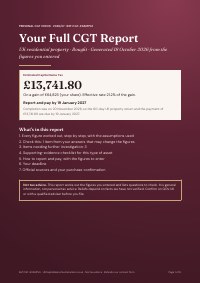
Before you go
Your Full CGT Report
- Every 2026/27 figure worked out from your own numbers
- Your deadline, and what to report and when
£4.99 one-off · instant download · full refund via our contact page
Sources & references
The rates, allowances and rules in this guide are drawn from the official HMRC and GOV.UK sources below, checked for the 2026/27 tax year. Each link opens the relevant government page in a new tab.
- Trusts and Capital Gains Tax (checked 27 Nov 2026) www.gov.uk/trusts-taxes/trusts-and-capital-gains-tax
- HS294 Trusts and Capital Gains Tax (2026) (checked 27 Nov 2026) www.gov.uk/government/publications/trusts-and-capital-gains-tax-hs294-self-assessment-helpsheet/hs294-trusts-and-capital-gains-tax-2026
- Capital Gains Tax rates and annual tax-free allowances (all years) www.gov.uk/government/publications/rates-and-allowances-capital-gains-tax/capital-gains-tax-rates-and-annual-tax-free-allowances
- Capital Gains Tax: rates and the £3,000 allowance for 2026 to 2027 (checked 22 Nov 2026) www.gov.uk/capital-gains-tax/rates