Gift Hold-Over Relief: Passing On a Business Asset Without a Tax Bill Today
Giving away an asset normally counts as disposing of it at its market value, so you can owe Capital Gains Tax on money you never received.2 Gift Hold-Over Relief stops that for qualifying business assets: you pay nothing when you give the asset away, and the person who receives it takes over your gain and pays any tax when they sell.1 It covers assets used in your own trade or your personal company's, and shares in unlisted trading companies.1 You and the recipient claim it together.1
- Business assets qualify if you are a sole trader or partner, or the company is your personal company (at least 5% of the voting rights).1
- Shares qualify if the company is not listed on a recognised stock exchange, or is your personal company, and mainly trades rather than invests. AIM does not count as a recognised stock exchange here.12
- Sell for less than market value and you are taxed now on what you received above your cost; only the rest is held over.2
- The recipient must generally be UK resident, unless the asset is an interest in UK land.2
- Joint claim on the HS295 form, sent with your Self Assessment return.1
Hold-over relief calculator
Enter what the asset is worth on the day you hand it over, what it cost you (including allowable buying and improvement costs), and anything the recipient pays you. Leave the payment at zero for an outright gift. The form posts your figures to us to work out the answer; nothing goes in the page address.
| Gain measured at market value | £160,000 |
| Taxed on you now (payment above your cost) | £0 |
| Gain held over to the recipient | £160,000 |
| Recipient's cost for their own later sale | £90,000 |
| Your CGT now for 2026/27 (no other gains) | £0 |
| Your CGT if you did not claim | £37,680 |
Tax after the £3,000 allowance, at 18% in the basic rate band left by your income and 24% above.3 The calculator assumes the whole asset qualifies. Partial business use and company investment assets cut the amount that can be held over, and are not modelled. Estimates, not tax advice.
Why a gift can create a tax bill at all
Capital Gains Tax does not care whether money changed hands. When you give an asset to anyone other than your spouse, civil partner or a charity, the gain is worked out as if you had sold it for what it was worth. HMRC's helpsheet puts it with a shop: sell it to your brother for £40,000 when it is worth £100,000, and without relief the tax is based on £100,000.2 For a family business handed down a generation, that can mean a large bill with no sale proceeds to pay it from.
Hold-over relief deals with that by moving the gain, not wiping it out. You pay nothing on the gift, and the recipient's cost is reduced by the gain you held over. When they eventually sell, their gain includes yours.1 Gifts to a spouse, civil partner or charity are a separate matter: tax is not usually payable on those in the first place.1 Our spouse transfer guide covers that route.
Worked example: an outright gift
HMRC's second example is an asset worth £50,000 given to a brother. It cost £17,000, so the gain is £33,000, and the brother's base cost becomes £17,000.2 Run through our calculator:
| Gain at market value | £33,000 |
| Held over | £33,000 |
| Taxed on the giver now | £0 |
| Brother's cost when he sells | £17,000 |
| Tax the giver would have paid without relief (£55,000 income) | £7,200 |
If the brother later sells for £60,000, his gain is measured from £17,000, not £50,000. The tax has been postponed and handed to him, which is worth talking through before the gift rather than after.
Worked example: selling to family below value
Plenty of transfers are part gift, part sale: a parent sells the business premises to a son or daughter for less than they are worth. HMRC's rule is that you are taxed straight away on the excess of what you receive over your base cost, and only the balance is held over.2 Its example is a shop worth £81,000 that cost £23,000, sold to a brother for £40,000.2
| Gain before relief | £58,000 |
| Taxed now: £40,000 less £23,000 | £17,000 |
| Held over | £41,000 |
| Buyer's cost going forward | £40,000 |
| Seller's CGT now for 2026/27 | £3,360 |
The price paid sets the immediate charge. Had the brother paid £23,000 or less, nothing would be taxed now and the whole £58,000 could be held over.
A sale to a charity at a discount works differently. HS295's fourth example is a shop worth £100,000 that cost £23,000 sold to a charity for £50,000, giving a chargeable gain of £27,000: the charity price less the cost.2
Which assets can be held over
Assets used in a trade
The asset must be used for a trade, profession or vocation carried on by you, by a partnership you are in, by your personal company, or by a member of a trading group whose holding company is your personal company.2 A personal company is one where you hold at least 5% of the voting rights.1 Typical examples are the workshop a sole trader owns, a partner's share of the firm's premises, or machinery a director owns personally and lets the company use.
Shares
Shares in a trading company qualify if the company is not listed on any recognised stock exchange, or if it is your personal company.1 Its main activities must be trading, not investment.1 Shares quoted on AIM count as unlisted for this purpose, because AIM is not a recognised stock exchange.2 Ordinary listed shares in a company you have a small stake in do not qualify, so giving away a portfolio of FTSE shares is a straightforward disposal at market value.
Gifts that are chargeable for Inheritance Tax
A second route covers gifts that are immediately chargeable transfers for Inheritance Tax, such as an individual giving an asset to the trustees of a trust other than a disabled trust. It does not cover gifts that are potentially exempt transfers.2 This is how a gain on almost any asset, not only a business one, can be held over when it goes into a discretionary trust. Our guide to trusts and CGT covers what happens to the gain once the trustees hold it.
When only part of the gain can be held over
Three situations shrink the relief, and each needs its own working:
- Land or buildings only partly used in the trade. The held-over amount is restricted and part of the gain is charged now.2 A shop with a let flat above is the usual case.
- An asset that was not used in the trade for part of your ownership. The same restriction applies.2
- Shares in a company holding investments. Where the company is your personal company, the held-over gain is restricted by reference to the company's non-business assets.2 A trading company sitting on a large cash pile or a let property can therefore pass on less than its whole gain.
GOV.UK's summary is shorter: you can usually get partial relief if you used the assets only partly for your business.1 The calculator above assumes full business use, so treat its held-over figure as the ceiling.
Recipients abroad, and recipients who later move
The person receiving the gift must generally be resident in the UK, unless what you give is an interest in UK land.2 Relief is also refused where the company is controlled by non-residents connected to you. You, the person giving, do not need to be UK resident.2
There is a six-year tail. If an individual who received a held-over gift emigrates within 6 years of the end of the tax year in which the gift was made, and still has the asset, the held-over gain is charged on them.2 For UK land, an election can defer that charge until the asset is disposed of. HMRC can in some cases collect the tax from the person who made the gift, so this is not purely the recipient's problem.2 For the wider picture on leaving the UK, see CGT for non-residents.
Gifts into trusts you can benefit from
No relief is available on a transfer to the trustees of a settlor-interested settlement. A settlement is settlor-interested if you, your spouse or civil partner, or your minor child or stepchild can benefit, or if arrangements exist under which you could acquire an interest.2 Disabled trusts and heritage maintenance funds are outside that exclusion. Relief already given is clawed back if the settlement becomes settlor-interested before the sixth anniversary of the start of the tax year after the transfer.2
How the claim is made
- Agree the market value of the asset on the date of the gift. You will both rely on it: you for the gain, the recipient for their future cost.
- Complete the claim form in helpsheet HS295. You and the recipient claim jointly; for a gift to the trustees of a settlement, you claim alone.2
- Use a separate form for each disposal.2
- Send the claim at the time of the gift, with your Self Assessment return. If you file online, upload a scanned copy.1
The recipient should keep a copy of the claim and the valuation with their own records, possibly for decades. When they sell, they need to show both the market value at the gift and the gain held over to reach their cost.
Property given to children
The business route only reaches assets used for a trade, profession or vocation.2 If what you want to hand over is a let house or a second home, the starting point is a disposal at market value, and a UK residential property may also need a 60-day return. Our guide to gifting property to children works through it, and CGT on gifts covers the general rules. If the business itself is being sold rather than given away, look at Business Asset Disposal Relief, and if it is being put into a company, incorporation relief.
Frequently asked questions
What does gift hold-over relief do?
It means you do not pay Capital Gains Tax when you give away qualifying business assets. The gain is held over, so the person you give the asset to pays any CGT when they sell or dispose of it.
Which assets qualify?
Assets used in your trade as a sole trader or partner, or by your personal company (at least 5% of the voting rights), and shares in a trading company that is not listed on a recognised stock exchange, or that is your personal company. AIM is not a recognised stock exchange for this purpose.
What if I sell the asset cheaply rather than give it away?
You pay tax now on any amount you receive above your original cost, and only the rest of the gain is held over. HMRC's example: a shop worth £81,000 that cost £23,000 sold to a brother for £40,000 gives a £17,000 gain now and £41,000 held over.
Who makes the claim?
You and the person receiving the gift claim jointly, on the form in helpsheet HS295 sent with your Self Assessment return. A gift to the trustees of a settlement is claimed by the person making it alone.
Can I hold over a gain on a gift to someone living abroad?
Generally not. The person receiving the asset must be UK resident unless the asset is an interest in UK land. If they emigrate within 6 years of the end of the tax year of the gift and still own it, the held-over gain can be charged.
General information for UK residents, not tax advice. Figures for 2026/27 disposals.
Before you go
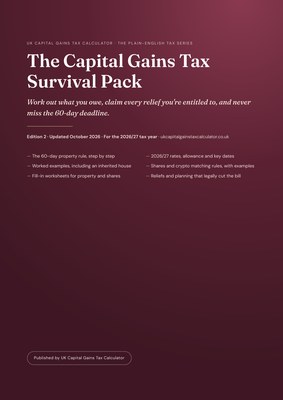
Capital Gains Tax Survival Pack
- The 60-day property deadline, step by step
- Share and crypto matching rules, with worksheets
£4.99 one-off · instant download · full refund via our contact page
Sources & references
The rates, allowances and rules in this guide are drawn from the official HMRC and GOV.UK sources below, checked for the 2026/27 tax year. Each link opens the relevant government page in a new tab.
- Gift Hold-Over Relief www.gov.uk/gift-holdover-relief
- HS295 Relief for gifts and similar transactions (2026) (checked 27 Nov 2026) www.gov.uk/government/publications/relief-for-gifts-and-similar-transactions-hs295-self-assessment-helpsheet/hs295-relief-for-gifts-and-similar-transactions-2026
- Capital Gains Tax: rates and the £3,000 allowance for 2026 to 2027 (checked 22 Nov 2026) www.gov.uk/capital-gains-tax/rates