Capital Gains Tax When a Company You Hold Shares In Is Taken Over
If you receive only shares in the buyer, there is normally nothing to pay yet: the new shares are treated as bought when, and for what, you bought the old ones.1 Cash is different. A cash payment is a part disposal, and your original cost is split between the cash and the new shares in proportion to their values.1 Cash under £3,000, or no more than 5% of what your shares were worth just before the deal, counts as small: it comes off your cost instead of being taxed now.1
- New shares in a reorganisation are not an acquisition, and losing the old ones is not a disposal.1
- Cash and shares: cost of the cash part = cost × cash ÷ (cash + value of new shares).1
- Small cash (under £3,000, or no more than 5%) is deducted from cost, with a gain only if it exceeds the cost.1
- Qualifying corporate bonds: the gain is fixed at the takeover and charged when you dispose of the bonds.1
- Any gain is taxed at 18% in your unused basic rate band and 24% above, after the £3,000 allowance.3
Takeover calculator: cash and shares
Enter the cost of your holding (your section 104 pool cost if you bought in stages), the cash you received, and the value of the new shares you were given. The company's takeover document usually tells you the value to use for listed shares. Your numbers are posted to us to work out the result and do not appear in the page address.
| Cash as a share of the total | 25.0% |
| Treatment | Part disposal: cost split by value |
| Cost set against the cash | £15,000 |
| Gain now | £65,000 |
| CGT for 2026/27 (no other gains) | £14,880 |
| Cost of your new shares for a later sale | £45,000 |
The 5% test uses the value of your old shares just before the takeover; we use cash plus new shares as that value, which is close for most offers. Tax after the £3,000 allowance at 18% and 24%.3 Loan notes are not modelled. Estimates, not tax advice.
Shares for shares: why nothing is due on the day
Takeovers paid in the buyer's own shares fall under the reorganisation rules. HMRC's helpsheet sets out the basic rule: the issue of new shares is not treated as an acquisition, and the loss or alteration of the old shares is not treated as a disposal.1 The new holding stands in the shoes of the old one, with the same acquisition date and the same cost, and merges with any shares of the buyer you already held.1
HS285's example: an investor holds 5,000 KNO shares that cost £6,000. KNO is bought by RST, which issues 5 of its shares for each KNO share. The investor now has 25,000 RST shares costing £6,000. They already owned 2,000 RST shares costing £8,000, so the combined holding is 27,000 RST shares with a cost of £14,000.1 When any of those RST shares are later sold, the normal matching rules apply: same day, then the next 30 days, then the section 104 pool.2
Cash and shares together
Many offers pay part in cash. The cash is a disposal of part of your holding, and you need a cost to set against it. HS285 splits the cost of the original shares in proportion to value: the cash, divided by the cash plus the value of the new shares.1
The helpsheet's example 7 is the one our calculator reproduces. A holding of 20,000 CDE shares with a pool cost of £60,000 is taken over for £80,000 in cash plus 40,000 WXY shares worth £6 each, £240,000 in total.1
| £55,000 income | £35,000 income | |
|---|---|---|
| Cost against the cash: £60,000 × 80,000 ÷ 320,000 | £15,000 | £15,000 |
| Gain on the cash | £65,000 | £65,000 |
| CGT for 2026/27 | £14,880 | £13,963.80 |
| Cost of the 40,000 WXY shares | £45,000 | £45,000 |
The gain of £65,000 matches HS285. The basic-rate investor pays less because part of the gain fits in the basic rate band left by their income and is taxed at 18%. Neither has used any of the £45,000 of cost carried into the new shares.
When the cash is small
A share-for-share deal sometimes comes with a little cash, for fractions of shares or a small cash sweetener. HMRC treats a cash receipt as small if it is less than £3,000 in total, or not more than 5% of the value of your shares in the original company immediately before the takeover.1 Small cash is not taxed straight away. It is deducted from the cost of the original shares instead, and there is only a gain now if the cash is more than that cost; any excess is a gain and the cost of the new shares falls to nil.1
| £2,500 cash, cost £10,000 | £4,000 cash (4%), cost £40,000 | |
|---|---|---|
| Small? | Yes, under £3,000 | Yes, no more than 5% |
| Gain now | £0 | £0 |
| Cost of the new shares | £7,500 | £36,000 |
In both cases the tax is deferred into a lower cost on the new shares, so the gain is bigger when you sell them. That suits someone whose annual allowance is already used this year.
Loan notes and qualifying corporate bonds
Some offers pay in loan notes rather than cash. If the loan notes are qualifying corporate bonds, the rule changes. The gain on your original shares is worked out as if they were sold at market value immediately before the takeover, but it is not charged until you dispose of the bonds.1 HS285's example has 1,000 JLM shares worth £5,000 that cost £3,500, giving a notional gain of £1,500; disposing of half the bonds releases £750 of it.1
Where an offer mixes cash and bonds, and the cash is not small, a proportion of the gain is charged at the takeover. In the helpsheet's version with £25,000 of cash and £75,000 of bonds, one quarter of the gain is charged at once.1 Our calculator does not handle bonds, because the frozen gain is charged in later years at whatever rates then apply.
Rights issues, bonus issues and different classes
The same helpsheet covers the smaller events in a shareholder's life, which change your cost without any sale:
- Bonus issues add shares and no cost: there is no allowable expenditure to add to the cost of the original shares.1
- Rights issues add what you pay for the new shares to the cost of the holding.1 HS285's example: 1,000 shares costing £7,000, then a 1-for-5 rights issue at £9 adds 200 shares for £1,800, so the pool becomes 1,200 shares costing £8,800. Selling 300 of them for £3,600 uses £2,200 of cost and gives a gain of £1,400, leaving 900 shares costing £6,600.1
- A new class of share splits the cost by value. Listed shares are valued on the first day prices are quoted after the reorganisation; unlisted shares at the date you dispose of them.1 In HS285's example 5 a pool of £2,425 is split £2,243 to the ordinary shares and £182 to the new "A" shares.1
Reporting the takeover
A pure share exchange has nothing to report in the year it happens, but you need to keep the paperwork: the offer document, the date, the exchange ratio, and the cost you have carried into the new holding. Years later, when you sell the new shares, that cost is what HMRC will expect to see.
Cash that is not small is a disposal in the tax year of the takeover. It goes on the capital gains pages of your Self Assessment return with the rest of that year's share sales; see SA108 boxes for listed shares. If the cash pushed your total proceeds or gains over the reporting limits, do I need to report explains the thresholds. Employees whose scheme shares were caught in a takeover should also read CGT on employee shares, and anyone with shares bought in dollars our foreign currency guide.
Frequently asked questions
Do I pay CGT when my shares are swapped for shares in the buyer?
Not at the time. Under the reorganisation rules the new shares are treated as acquired when, and for what, you paid for the old ones, so the gain waits until you sell the new shares.
What if I receive cash as well as shares?
The cash is a part disposal. Your cost is split by value: cost multiplied by the cash divided by the cash plus the value of the new shares. The rest of the cost carries over to the new shares.
What counts as a small amount of cash?
Less than £3,000 in total, or not more than 5% of the value of your shares in the original company immediately before the takeover. Small cash comes off your cost instead of being taxed now, unless it is more than the cost.
What about loan notes?
If the loan notes are qualifying corporate bonds, the gain on your old shares is worked out at the takeover but only charged when you dispose of the loan notes.
Does a rights issue change my cost?
Yes. What you pay for the rights shares is added to the cost of your existing holding. A bonus issue adds shares but no cost.
General information for UK residents, not tax advice. Figures for 2026/27 disposals.
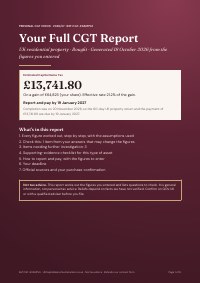
Before you go
Your Full CGT Report
- Every 2026/27 figure worked out from your own numbers
- Your deadline, and what to report and when
£4.99 one-off · instant download · full refund via our contact page
Sources & references
The rates, allowances and rules in this guide are drawn from the official HMRC and GOV.UK sources below, checked for the 2026/27 tax year. Each link opens the relevant government page in a new tab.
- HS285 Share reorganisations, company takeovers and Capital Gains Tax (2026) (checked 27 Nov 2026) www.gov.uk/government/publications/share-reorganisations-company-takeovers-and-capital-gains-tax-hs285-self-assessment-helpsheet/hs285-share-reorganisations-company-takeovers-and-capital-gains-tax-2026
- Shares and Capital Gains Tax (Helpsheet HS284) www.gov.uk/government/publications/shares-and-capital-gains-tax-hs284-self-assessment-helpsheet
- Capital Gains Tax: rates and the £3,000 allowance for 2026 to 2027 (checked 22 Nov 2026) www.gov.uk/capital-gains-tax/rates