Incorporation Relief: Moving Your Business Into a Company Without a CGT Bill
When a sole trader or partnership hands its business to a new company, the assets that go across are disposed of to the company, and any that have risen in value carry a gain. Incorporation relief, under section 162 of the Taxation of Chargeable Gains Act 1992, stops the gain being taxed straight away if the whole business goes in as a going concern and the company pays at least partly in shares.1 The gain comes off the cost of the shares instead.4 The big change is procedural: for transfers on or after 6 April 2026 the relief needs a claim, made by the first anniversary of the 31 January after the tax year of the transfer.3 For a 2026/27 transfer that is 31 January 2029.3
- Three conditions: going concern; all the assets (or all except cash); paid wholly or partly in new shares.1
- Relief = total net gains × cost of the shares ÷ whole consideration, capped at the cost of the shares.4
- Transfers from 6 April 2026: claim in writing, normally in or with the return for that year.3
- Letting property can be a business: HMRC accepts relief at 20 hours a week or more of business-type activity.2
- Any part paid in cash or credited to you is taxed now at 18% or 24%.5
Incorporation relief calculator
Enter the total net gains on everything the business transfers, the whole price the company gives you for it, and how much of that price is in shares. Anything else (cash, or an amount the company owes you on a director's loan account) is treated as non-share consideration. Inputs go in the posted form only.
| Share of the price taken as shares | 75.0% |
| Gain held over into the shares | £150,000 |
| Gain taxed now (the cash or loan account part) | £50,000 |
| CGT now for 2026/27 | £11,280 |
| CGT if there were no relief | £47,280 |
| CGT cost of your shares for a later sale | £300,000 |
Formula from HMRC's manual: gains × A ÷ B, where A is the cost of the shares and B is the whole consideration; the relief cannot exceed A.4 Tax after the £3,000 allowance at 18% and 24%.5 Other reliefs on the part taxed now are not modelled. Not tax advice.
Is the relief still automatic?
No, not for anything transferred on or after 6 April 2026. HMRC's manual says relief under section 162 now requires a claim including the details HMRC requires. The claim must be in writing, and you can choose its format.3 Older guidance that tells you there is nothing to do is describing transfers made before that date.
Where the claim goes:
- Normally in or with the Self Assessment return for the year of the transfer, identifying the disposals covered and the total relief claimed.3
- Supporting details are uploaded as an attachment to a digital return, or entered in box 54 of a paper SA108.3
- It can also be made by written request, for example alongside a Capital Gains Tax on UK property return.3
- The details include what kind of transferor you are: an individual, trustee, partnership or LLP.3
The deadline is the first anniversary of the 31 January following the tax year of the transfer, under section 162(1)(b). HMRC's own example gives 31 January 2029 for a transfer in 2026/27.3 That is a year longer than the normal return deadline, but missing it means the whole gain is taxed for the year of transfer.
The three conditions
Section 162(1), as set out at CG65710, needs all three:1
- The business is transferred as a going concern.
- The whole of the assets of the business, or the whole of them other than cash, are transferred to the company.
- The company pays for the transfer wholly or partly by issuing shares in itself.
The second condition is the one that trips people up. Keeping the building outside the company and letting it to the new company means not all the assets have gone in, so section 162 is not met. Cash is the one asset you can hold back.1 If you want to keep a business asset personally, look instead at whether gift hold-over relief fits.
How the gain is split between now and later
CG65740 gives the computation: multiply the aggregate net gains by A over B, where A is the cost of the shares and B is the value of the whole consideration the transferor receives for the business.4 The amount held over cannot be more than the cost of the shares, under section 162(4).4 The held-over amount reduces the cost of the shares, so when you sell them later the gain is larger.
| All in shares | £350,000 shares, £150,000 loan account | |
|---|---|---|
| Gain held over | £150,000 | £105,000 |
| Gain taxed now | £0 | £45,000 |
| CGT now (£55,000 income) | £0 | £10,080 |
| CGT cost of the shares | £350,000 | £245,000 |
Whatever is not paid in shares brings its share of the gain into charge straight away. In the second column 30% of the price is non-share, so 30% of the gain, £45,000, is chargeable for the year of transfer.
The calculator's default case is a £600,000 business with £200,000 of gains, three-quarters taken in shares: £150,000 is held over and £50,000 is taxed now, with a CGT bill of £11,280 against £47,280 with no relief.
Landlords: is a rental portfolio a "business"?
This is the question behind most incorporation relief searches. TCGA 1992 does not define "business", so it takes its normal meaning, which includes a trade but goes wider.2 Whether letting property is a business is a question of fact.
HMRC's manual relies on the Upper Tribunal decision in Ramsay v HMRC [2013] UKUT 0226 (TCC). Mrs Ramsay had lost at the First-tier Tribunal because her work was seen as normal and incidental to owning an investment property; the Upper Tribunal said the test is the degree of activity as a whole.2 She spent about 20 hours a week on the property, and that was enough.2
HMRC now says relief should be accepted where an individual spends 20 hours or more a week on activities that indicate a business. Below that, the case should be considered carefully against the factors listed in the manual.2 Twenty hours is a guide, not a cliff edge, but it is the figure HMRC will look for. Keep a diary of what you actually do: finding tenants, arranging repairs, inspections, dealing with arrears.
A transfer of let homes into a company is also a disposal of UK residential property, which ties in with the 60-day reporting rules; our guide to reporting a UK property gain covers that return, and HMRC accepts the incorporation claim alongside it.3
A worked check before you sign
- List every asset going into the company with its market value and your base cost. Our allowable costs guide covers what goes into the cost.
- Add up the aggregate net gains on the assets transferred. That is the figure the formula works on.4
- Decide how much of the price you want as shares and how much as a loan account. Every pound of non-share consideration brings a proportion of the gain into charge now.4
- Diary the claim deadline: 31 January 2029 for a 2026/27 transfer.3
- Keep the valuation evidence and the transfer agreement with your records.
What happens when you sell the shares
The held-over gain sits inside the shares. Sell them for £600,000 when their CGT cost is £350,000, and the gain on that sale includes the £150,000 you did not pay tax on at incorporation. Whether a later sale of the company qualifies for Business Asset Disposal Relief depends on the BADR conditions at that time; our business sale guide covers them.
Incorporation relief is one of several ways to postpone a gain on business assets. If you are selling one property to buy another for the same trade, rollover relief is the usual route. HMRC's helpsheet on this relief is HS276, listed in our helpsheets index.
Frequently asked questions
Is incorporation relief still automatic?
Not for transfers on or after 6 April 2026. HMRC's manual says relief now requires a claim including the details HMRC asks for, normally made in or with the tax return for the year of the transfer.
When is the deadline to claim?
By the first anniversary of the 31 January following the tax year of the transfer. For a transfer in 2026/27 that is 31 January 2029.
What conditions must the transfer meet?
The business must be transferred as a going concern, with the whole of its assets (or all of them except cash), and the company must pay at least partly by issuing shares.
How much of the gain is held over?
The total net gains multiplied by the cost of the shares divided by the whole consideration you receive. Any part paid in cash or by a credit to a loan account is taxed now. The amount held over cannot be more than the cost of the shares.
Can a buy-to-let landlord get incorporation relief?
Only if the letting is a business. HMRC's manual follows the Ramsay case: the degree of activity as a whole decides it, and HMRC accepts relief where someone spends 20 hours or more a week on business-type activities. Below that, it looks at the facts carefully.
General information for UK residents, not tax advice. Incorporating has other tax effects (for example Stamp Duty Land Tax on property) that this page does not cover. Figures for 2026/27 disposals.
Before you go
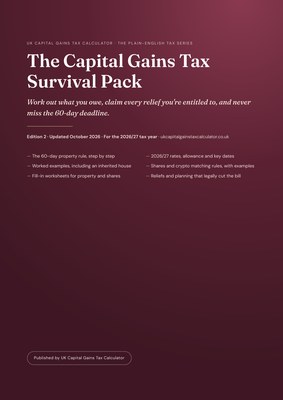
Capital Gains Tax Survival Pack
- The 60-day property deadline, step by step
- Share and crypto matching rules, with worksheets
£4.99 one-off · instant download · full refund via our contact page
Sources & references
The rates, allowances and rules in this guide are drawn from the official HMRC and GOV.UK sources below, checked for the 2026/27 tax year. Each link opens the relevant government page in a new tab.
- HMRC Capital Gains Manual CG65710: incorporation relief, conditions (checked 27 Nov 2026) www.gov.uk/hmrc-internal-manuals/capital-gains-manual/cg65710
- HMRC Capital Gains Manual CG65715: incorporation relief, meaning of business (checked 27 Nov 2026) www.gov.uk/hmrc-internal-manuals/capital-gains-manual/cg65715
- HMRC Capital Gains Manual CG65735: claim for incorporation relief, transfers from 6 April 2026 (checked 27 Nov 2026) www.gov.uk/hmrc-internal-manuals/capital-gains-manual/cg65735
- HMRC Capital Gains Manual CG65740: incorporation relief computation (checked 27 Nov 2026) www.gov.uk/hmrc-internal-manuals/capital-gains-manual/cg65740
- Capital Gains Tax: rates and the £3,000 allowance for 2026 to 2027 (checked 22 Nov 2026) www.gov.uk/capital-gains-tax/rates