Gilts and Capital Gains Tax: The Gain Is Exempt, the Coupon Is Not
Yes, UK government gilts are exempt from Capital Gains Tax, and so are qualifying corporate bonds. The law says a gain on disposing of them "shall not be a chargeable gain", whether you sell in the market or hold to redemption.2 The other side is that a loss on them is not an allowable loss either.4 The interest (the coupon) is a different matter: it is savings income and is taxed at 20%, 40% or 45% in 2026/27, rising to 24%, 44% and 49% from 6 April 2027.567 That split is why gilts bought below £100 with a small coupon are popular with higher-rate taxpayers: most of the return arrives as a tax-free gain.
- GOV.UK lists UK government gilts and qualifying corporate bonds among the investments you do not pay CGT on.1
- Exemption: gilt-edged securities, qualifying corporate bonds, and options or contracts over them (TCGA 1992 s115).2
- Losses on them are not allowable losses (s16(2)).4
- Coupons are interest, which is savings income (ITA 2007 s18).5
- Savings rates: 20% / 40% / 45% in 2026/27; 24% / 44% / 49% in 2027/28.6
- Personal Savings Allowance: £1,000 basic rate, £500 higher rate, in both years.6
Gilt return calculator
Enter the nominal amount (the £100 units the gilt will repay), the price you pay per £100, the coupon rate, the years to redemption and the Income Tax rate that applies to your interest. We split the return into the tax-free gain and the taxable coupons, and show what a fully taxed savings account would have to pay to leave you with the same. Inputs are posted, not shown in the address.
| You pay | £9,650 |
| Gain to redemption at £100 (no CGT) | £350 |
| Coupons over the period | £25 |
| Income Tax on the coupons at 40% | £10 |
| Return after tax | £365 |
| Share of the return lost to tax | 2.67% |
| Gross interest a fully taxed account would need to pay | £608.33 |
| As a simple yearly rate on what you pay | 3.15% (gilt before tax: 1.94%) |
Simple, not compound, yearly rates; coupons are not reinvested. Dealing costs, the Personal Savings Allowance and the Accrued Income Scheme are not modelled.8 The figures you enter are your own: we do not quote live gilt prices. Estimates, not tax advice.
What the law exempts
Section 115 of the Taxation of Chargeable Gains Act 1992 says that a gain which accrues on the disposal by any person of gilt-edged securities or qualifying corporate bonds, or of any option or contract to acquire or dispose of them, "shall not be a chargeable gain".2 The exemption is not limited to holding to maturity. A gilt bought at £96 and sold a year later at £99 makes a gain that is just as exempt as one held until it repays £100.
GOV.UK puts it in plain terms on its page for people selling shares and investments: you do not pay Capital Gains Tax when you dispose of UK government gilts, and the same list includes Premium Bonds and qualifying corporate bonds.1 The same page lists "certain bonds (not including Premium Bonds and Qualifying Corporate Bonds)" among the investments you may pay tax on, which is the reminder that not every bond is exempt.1
The catch: losses are not allowable
The exemption cuts both ways. Section 16(2) of the same Act says that the provisions which decide whether a gain is chargeable also decide whether a loss is allowable.4 Because a gain on a gilt is not a chargeable gain, a loss on a gilt is not an allowable loss. If interest rates rise after you buy and you sell below your purchase price, the loss cannot be set against gains on shares, funds or property.
That matters most for long-dated gilts, whose prices move furthest when rates change. Holding to redemption removes the price risk, because a gilt repays £100 per £100 nominal on its redemption date, but a forced sale before then can crystallise a loss you cannot use.
The coupon is savings income
The interest a gilt pays is taxed like bank interest. Savings income for Income Tax includes "income chargeable under Chapter 2 of Part 4 of ITTOIA 2005 (interest)".5 In 2026/27 the savings basic, higher and additional rates are 20%, 40% and 45%; the Personal Savings Allowance takes the first £1,000 of savings income out of tax for a basic-rate taxpayer and the first £500 for a higher-rate taxpayer, and the starting rate for savings is 0% with a starting rate limit of £5,000.6
Budget 2026 raised the stakes. From 2027 to 2028, the government will legislate in Finance Bill 2026-27 for a savings basic rate of 24%, a savings higher rate of 44% and a savings additional rate of 49%, taking effect from 6 April 2027 across the UK.7 The Personal Savings Allowance stays at £1,000 and £500.6 Interest on deposits and coupons on gilts both bear the higher rates; the redemption gain on a gilt does not, because it is not income.
Worked example: a low-coupon gilt for a higher-rate taxpayer
Take a gilt with a 0.125% coupon and two years to run, bought at £96.50 per £100 nominal. These are illustrative figures, not a quote for any real gilt. A higher-rate taxpayer whose Personal Savings Allowance is already used by bank interest buys £10,000 nominal.
| 40% (2026/27) | 44% (2027/28) | 45% (2026/27) | |
|---|---|---|---|
| Cost | £9,650 | £9,650 | £9,650 |
| Tax-free gain to £100 | £350 | £350 | £350 |
| Coupons | £25 | £25 | £25 |
| Tax on coupons | £10 | £11 | £11.25 |
| Return after tax | £365 | £364 | £363.75 |
| Gross interest needed in a taxed account | £608.33 | £650 | £661.36 |
| Simple yearly rate that equals | 3.15% | 3.37% | 3.43% |
Only 2.67% of the higher-rate taxpayer's return goes in tax, because £350 of the £375 total comes as exempt gain. A savings account would need to pay about 3.15% a year gross to match the gilt's 1.94% for the same person. For a basic-rate taxpayer the gap is smaller: the equivalent is 2.4%.
Compare a gilt with a 4.5% coupon bought at £99 for the same two years. Its return before tax is higher, but £900 of it is coupon, the tax is £360 at 40%, and 36% of the return goes in tax. Whether the low-coupon gilt is better depends on the prices on the day; the calculator lets you test both with real prices from your broker.
Qualifying corporate bonds
The exemption also covers qualifying corporate bonds. Section 117 sets the test: broadly, a security whose debt represents and has always represented a "normal commercial loan", which is expressed in sterling and for which no provision is made for conversion into, or redemption in, a currency other than sterling.3 Deeply discounted securities are also included as corporate bonds.3 A bond denominated in dollars or euros fails the sterling test, and a gain on a bond that is not a qualifying corporate bond can be chargeable.
Qualifying corporate bonds also turn up in company takeovers, where they change how the gain on your old shares is treated; see CGT on a share takeover.
Buying between coupon dates: the Accrued Income Scheme
When you buy a gilt between interest dates, the price includes interest that has built up since the last coupon. The Accrued Income Scheme taxes that accrued interest as income rather than letting it be turned into an exempt gain. HMRC's manual explains that it was introduced to tackle "bondwashing", that it applies to most marketable securities such as government or corporate bonds, and that the amount taxable as income is removed from the sale and purchase figures for capital gains purposes.8 It also lists exemptions, including for holdings of securities of less than £5,000.8 If your holdings are larger, expect your broker's contract notes to show accrued interest separately, and keep them.
Gilt funds and ETFs are different
The exemption belongs to the gilt itself. A fund or ETF that holds gilts is a separate asset: units in a unit trust and shares in an OEIC are taxed like shares, so a gain on selling them is a chargeable gain even if every holding in the fund is a gilt.1 Funds based outside the UK bring the offshore fund rules into play; see offshore funds and CGT. A gilt you hold directly keeps the exemption.
Inside an ISA or a pension the comparison disappears: neither the coupon nor the gain is taxed there, so a high-coupon gilt loses nothing; see CGT and ISAs. Outside one, gilts are one of the few assets where nothing goes on the capital gains pages of your return, which is also why they appear in our list of what you never report.
Frequently asked questions
Do you pay capital gains tax on gilts?
No. A gain on the disposal of gilt-edged securities is not a chargeable gain (section 115 of the Taxation of Chargeable Gains Act 1992). GOV.UK lists UK government gilts among the investments you do not pay CGT on.
Is the interest on gilts taxable?
Yes. The coupon is interest, which is savings income for Income Tax. The Personal Savings Allowance (£1,000 for basic rate, £500 for higher rate taxpayers) can cover some of it, but the gain at redemption is not interest and is not taxed.
Can I claim a loss on gilts?
No. The provisions that make a gain not chargeable also make a loss not allowable (section 16(2) of the 1992 Act), so a loss on selling a gilt below what you paid cannot be set against other gains.
Why are low-coupon gilts popular?
Most of their return comes as the rise in price to £100 at redemption, which is free of CGT, rather than as taxable coupons. The higher your Income Tax rate, the more that split is worth, and savings rates rise to 24%, 44% and 49% from 6 April 2027.
Are corporate bonds free of CGT too?
Qualifying corporate bonds are. Broadly that means a sterling bond representing a normal commercial loan, with no right to convert into or be redeemed in another currency. Bonds that fail the test, such as many foreign-currency bonds, are not exempt.
General information for UK residents, not tax advice. Figures for 2026/27, with the announced 2027/28 savings rates.
Before you go
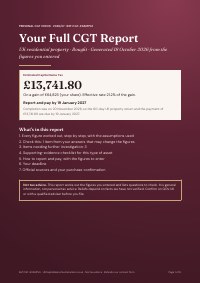
Your Full CGT Report
- Every 2026/27 figure worked out from your own numbers
- Your deadline, and what to report and when
£4.99 one-off · instant download · full refund via our contact page
Sources & references
The rates, allowances and rules in this guide are drawn from the official HMRC and GOV.UK sources below, checked for the 2026/27 tax year. Each link opens the relevant government page in a new tab.
- Tax when you sell shares: what you pay it on (checked 29 Nov 2026) www.gov.uk/tax-sell-shares/what-you-pay-it-on
- Taxation of Chargeable Gains Act 1992, section 115: exemptions for gilt-edged securities and qualifying corporate bonds (checked 29 Nov 2026) www.legislation.gov.uk/ukpga/1992/12/section/115
- Taxation of Chargeable Gains Act 1992, section 117: meaning of qualifying corporate bond (checked 29 Nov 2026) www.legislation.gov.uk/ukpga/1992/12/section/117
- Taxation of Chargeable Gains Act 1992, section 16: computation of losses (checked 29 Nov 2026) www.legislation.gov.uk/ukpga/1992/12/section/16
- Income Tax Act 2007, section 18: meaning of savings income (checked 29 Nov 2026) www.legislation.gov.uk/ukpga/2007/3/section/18
- Budget 2026 OOTLAR, Annex A: savings rates and Personal Savings Allowance, 2026 to 2027 and 2027 to 2028 (checked 29 Nov 2026) www.gov.uk/government/publications/budget-2026-overview-of-tax-legislation-and-rates-ootlar/annex-a-rates-and-allowances
- Budget 2026: Overview of tax legislation and rates (savings rates 1.1, cryptoasset loans 1.48) (checked 29 Nov 2026) www.gov.uk/government/publications/budget-2026-overview-of-tax-legislation-and-rates-ootlar/budget-2026-overview-of-tax-legislation-and-rates-ootlar
- HMRC Savings and Investment Manual SAIM4010: background to the Accrued Income Scheme (checked 29 Nov 2026) www.gov.uk/hmrc-internal-manuals/savings-and-investment-manual/saim4010
- Capital Gains Tax: rates (18% and 24% from 6 April 2026, £3,000 allowance for 2026 to 2027) (checked 29 Nov 2026) www.gov.uk/capital-gains-tax/rates