Selling Your Company to an Employee Ownership Trust: the 50% CGT Relief
Until 25 November 2025, selling a controlling stake in a trading company to an Employee Ownership Trust could be completely free of Capital Gains Tax. For disposals on or after 26 November 2025, only half of the gain is exempt; the other half is your chargeable gain for the year of sale.12 The exempt half is not lost to HMRC either: it is deducted from the trustees' acquisition cost, so it is taxed if the trust ever sells.1 And if you claim EOT relief you cannot also claim Business Asset Disposal Relief or Investors' Relief.2 That turns the decision into a sum worth doing: half the gain at normal rates, against the whole gain with BADR.
- From 26 November 2025: 50% of the gain is chargeable on the seller, 50% held over against the trustees' cost.1
- On or before 25 November 2025: the full gain was exempt.2
- No BADR or Investors' Relief where EOT relief is claimed.12
- Relief is withdrawn if the trust fails the conditions in the four tax years after the year of sale.2
- Individuals and some trustees can claim; companies cannot.2
EOT relief or BADR: calculator
Enter your gain on the shares, your income for the year, and any BADR you (or Entrepreneurs' Relief) have used before. We show the 2026/27 tax under EOT relief and under BADR, so you can see which route leaves you with more. Your numbers are posted with the form, never added to the address.
| Amount | |
|---|---|
| Gain chargeable on you under EOT relief (half) | £1,000,000 |
| Gain held over against the trustees' cost | £1,000,000 |
| CGT with EOT relief | £239,280 |
| Gain within your BADR lifetime limit | £1,000,000 |
| CGT with BADR instead | £419,280 |
| CGT with no relief at all | £479,280 |
On these figures EOT relief costs £180,000 less in tax this year. Tax at 18% and 24% after the £3,000 allowance; BADR at 18% up to the lifetime limit.34 This compares tax only. It does not test whether the trust or the company meets the EOT conditions, and price, timing and the clawback risk matter as much as the rate. Not tax advice.
What changed on 26 November 2025
HMRC published the measure on Budget day, 26 November 2025. It affects individuals and trustees who dispose of shares to the trustees of an Employee Ownership Trust, and says that 50% of the gain on disposal will be treated as the disposer's chargeable gain. The remaining 50% is not chargeable at the time of disposal; it is held over and deducted from the trustees' acquisition cost.1
The relief lives in sections 236H to 236U of the Taxation of Chargeable Gains Act 1992, with the changes made through Finance Bill 2025-26.1 Sales on or before 25 November 2025 keep the old treatment, where the full gain was exempt.2
HMRC's own example: a £5 million gain
HS277 works through a disposal on 1 December 2025 with a gain of £5 million: £2.5 million is exempt and £2.5 million is chargeable. Only the chargeable half goes on the capital gains pages of the return.2 Moved into 2026/27 and set against BADR, the same gain looks like this for someone with £55,000 of other income and no earlier BADR claims:
| Chargeable under EOT relief | £2,500,000 |
| CGT with EOT relief | £599,280 |
| CGT with BADR (only the first £1,000,000 at 18%) | £1,139,280 |
| CGT with neither | £1,199,280 |
On a gain this size the 50% exemption is worth far more than BADR, because BADR only reaches the first part of the gain and only saves the difference between 18% and 24% on it.
Where the answer flips
On smaller gains the two routes come closer. Here are three sizes side by side:
| Gain | EOT relief | BADR | No relief |
|---|---|---|---|
| £600,000 | £71,280 | £107,460 | £143,280 |
| £2,000,000 | £239,280 | £419,280 | £479,280 |
| £5,000,000 | £599,280 | £1,139,280 | £1,199,280 |
With main rates of 18% and 24% and BADR at 18%, halving the taxable gain beats cutting the rate on part of it at every size shown. The gap changes if you have used some BADR already, so enter that figure if you have. Use the calculator with your own figures. Our BADR calculator shows the BADR side in more detail.
The conditions HS277 points to
The helpsheet is an introduction and sends you to HMRC's Capital Gains Manual for the full conditions the trust must meet in the year of disposal.2 It does spell out a few points that catch people out:
- The shares must be in a trading company.2
- Relief is only available for disposals in the tax year in which the trustees acquire the controlling shareholding. Selling a top-up stake in a later year is outside it.2
- Individuals and some trustees of settlements can claim. A company selling shares cannot.2
Take advice on the trust deed and the company's structure before exchange. The tax arithmetic on this page assumes the conditions are met.
The four-year clawback
If the trust stops meeting the relief conditions at any time in the four tax years following the tax year of disposal, relief cannot be claimed, and any relief already claimed is withdrawn.2 For a sale in 2026/27 that watch runs to the end of 2030/31. A seller who stays on as a director, or whose deferred price depends on the company's profits, has a direct interest in the trust staying compliant through that period.
Being paid over several years
Many EOT purchases are funded from future profits, so the price arrives in instalments while the tax on the chargeable half is due by the normal date. HS277 explains that you may apply under section 280 TCGA 1992 to pay the tax in instalments where the consideration instalments begin no earlier than the date of disposal, run over more than 18 months, and continue past the date the tax would otherwise be due.2 The application goes in writing to HMRC's Capital Gains Tax Queries address, with "Section 280 TCGA 1992" clearly in the heading.2
How to claim
Claim EOT relief on your Self Assessment return for the tax year of the sale. HS277 lists what to include: details identifying the trust, the company's name and registered office address, the date of disposal, the number of shares disposed of, the consideration, and the number of employees of the company at the date of disposal. These can go in the "Any other information" box.2 The chargeable half is entered on the capital gains pages in the normal way.
Because BADR and Investors' Relief are shut off once EOT relief is claimed,1 decide which route you are taking before the return is filed. For the wider picture on selling a company, see CGT on selling a business and the BADR guide; external shareholders selling at the same time may be looking at Investors' Relief.
What the trustees inherit
The held-over half reduces the trustees' acquisition cost.1 If the trust later sells the company to a third party, its gain includes the amount you did not pay tax on. The relief is built so that the exempt half is postponed to the trustees, not forgiven. Trustees' own gains are taxed at 24%; our trusts guide explains their allowance and rates.
Frequently asked questions
How much CGT relief do I get selling to an EOT now?
For disposals on or after 26 November 2025, half of the gain is exempt and half is chargeable on you in the year of sale. For disposals on or before 25 November 2025 the full gain was exempt.
What happens to the other half of the gain?
It is held over and deducted from the trustees' acquisition cost, so it comes into charge when the trustees later dispose of the shares.
Can I claim BADR on the half that is taxed?
No. Business Asset Disposal Relief and Investors' Relief are not available where EOT relief has been claimed.
Can the relief be taken back later?
Yes. If the trust stops meeting the relief conditions at any time in the four tax years after the tax year of the sale, the relief is withdrawn.
Can I pay the tax in instalments if the trust pays me over time?
You can apply to HMRC under section 280 TCGA 1992 if the instalments start no earlier than the sale, run for more than 18 months and continue past the date the tax would otherwise be due.
General information for UK residents, not tax or legal advice. Figures for 2026/27 disposals.
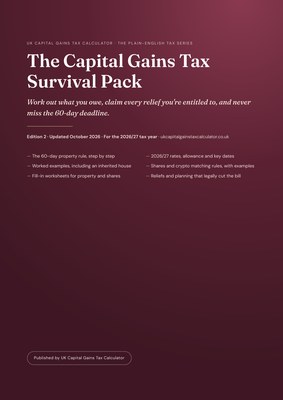
Before you go
Capital Gains Tax Survival Pack
- The 60-day property deadline, step by step
- Share and crypto matching rules, with worksheets
£4.99 one-off · instant download · full refund via our contact page
Sources & references
The rates, allowances and rules in this guide are drawn from the official HMRC and GOV.UK sources below, checked for the 2026/27 tax year. Each link opens the relevant government page in a new tab.
- Capital Gains Tax: Employee Ownership Trusts relief reduction (published 26 Nov 2025, checked 27 Nov 2026) www.gov.uk/government/publications/capital-gains-tax-employee-ownership-trusts/capital-gains-tax-employee-ownership-trusts-relief-reduction
- HS277 Employee Ownership Trusts and Capital Gains Tax (2026) (checked 27 Nov 2026) www.gov.uk/government/publications/employee-ownership-trusts-and-capital-gains-tax-self-assessment-helpsheet-hs277/hs277-employee-ownership-trusts-and-capital-gains-tax-2026--2
- Business Asset Disposal Relief www.gov.uk/business-asset-disposal-relief
- Capital Gains Tax: rates and the £3,000 allowance for 2026 to 2027 (checked 22 Nov 2026) www.gov.uk/capital-gains-tax/rates