Investors' Relief: 18% CGT on Shares in Unlisted Trading Companies
Investors' Relief is the outside investor's version of Business Asset Disposal Relief. If you subscribed cash for new ordinary shares in an unlisted trading company, the shares were issued on or after 17 March 2016, and you have held them for at least three years, the gain can be taxed at 18% for disposals from 6 April 2026.1 The lifetime limit is £1 million of gains per person for disposals from 30 October 2024.2 It is not usually available if you, or someone connected with you, works for the company or is an officer of it.1 For a higher-rate taxpayer the saving is 6p in every pound of gain that would otherwise be taxed at 24%.
- Rate: 18% from 6 April 2026; 14% from 6 April 2025; 10% before that.1
- Lifetime limit: £1 million; £10 million for disposals on or before 29 October 2024.1
- Shares: ordinary, subscribed for in cash, fully paid, issued on or after 17 March 2016, held 3 years.1
- Company: trading, with none of its shares listed on a stock exchange.1
- The relief has to be claimed; without a claim the normal rates apply.3
Investors' Relief calculator
Enter the qualifying gain, any Investors' Relief you have already used on earlier sales, your income and any other gains this year. We apply the £1 million limit, set the allowance where it saves most, and work out 2026/27 tax with and without the relief. Inputs are posted, not shown in the address.
| Lifetime limit left before this sale | £1,000,000 |
| Gain taxed at 18% (after any allowance) | £297,000 |
| Other gains taxed at 18% / 24% | £0 / £0 |
| Total CGT with Investors' Relief | £53,460 |
| Total CGT without it | £71,280 |
| Saving | £17,820 |
| Lifetime limit left afterwards | £700,000 |
The £3,000 allowance goes against other gains first, because they could be taxed at 24%. Relief gains use up your unused basic rate band before other gains do, so other gains may be pushed up to 24%.4 Losses are not modelled: HMRC deducts allowable losses before the lower rate is applied.2 Estimates, not tax advice.
Who the relief is for
HMRC describes the relief as targeted at external investors.2 The model case is an angel backer who puts money into a growing private company in return for newly issued shares and sells out years later. A founder who runs the company is the person BADR is designed for; an investor who never works there is the person Investors' Relief is designed for.
That is why the employment exclusion matters. HS308 says the relief is not usually available if you or someone connected with you is an officer or employee of the company. There is one opening: if you become an unpaid director of a company you have invested in, you may still be able to claim.1 HMRC's manual adds that trustees can claim against the lifetime cap of an individual beneficiary in certain circumstances, and that shares held jointly can qualify.2
The conditions, one by one
| Test | What it means |
|---|---|
| New shares | You subscribed for them in cash and they were fully paid up when issued. Buying existing shares from another shareholder does not count.1 |
| Ordinary shares | They must be ordinary shares.1 |
| Issue date | On or after 17 March 2016.1 |
| Holding period | Owned for at least three years up to the date of disposal. Some shares received in a reorganisation can count as held from an earlier date.12 |
| Unlisted | None of the company's shares are listed on a stock exchange.1 |
| Trading company | The company must be a trading company.1 |
| New money | The subscription must be new money that benefits the company.2 |
| Not an employee or officer | Usually fatal if you or a connected person is one; unpaid directors may still qualify.1 |
If only some of the shares in a holding qualify, the 18% rate applies to a proportion of the gain rather than all of it.2 That often happens when someone subscribed in one round and bought second-hand shares later.
Worked example: a £300,000 gain
An investor with £60,000 of salary sells qualifying shares in 2026/27 at a gain of £300,000 and has never claimed the relief before.
| Gain taxed at 18% after the allowance | £297,000 |
| CGT with Investors' Relief | £53,460 |
| CGT at 24% without it | £71,280 |
| Saving | £17,820 |
| Lifetime limit left | £700,000 |
Worked example: going over the £1 million limit
The limit is cumulative over your lifetime, not annual.1 A £1.2 million gain with no earlier claims uses the whole limit and leaves £200,000 taxed at the normal rate.
| Gain within the limit, at 18% | £1,000,000 |
| Gain above the limit | £200,000 |
| Allowance set against the excess, which would be taxed at 24% | £3,000 |
| Total CGT | £227,280 |
| Without the relief | £287,280 |
The limit was £10 million for disposals on or before 29 October 2024 and has been £1 million since.1 HMRC's manual has a separate page on applying the lifetime cap.2
Basic-rate taxpayers: the relief can push other gains up
Section 1I of the Taxation of Chargeable Gains Act 1992 treats gains taxed at 18% under the BADR and Investors' Relief sections together as "entrepreneur or investor gains". They are set against your unused basic rate band first, and any other gains only get what band is left.4 The relief's own rate comes from section 169VC: if a claim is made, the rate on the relevant gain is 18%.3
For a basic-rate taxpayer that ordering can bite. Take someone with £30,000 of income, a £40,000 qualifying gain and £20,000 of gains on listed shares in the same year:
| Qualifying gain at 18% | £40,000 |
| Other gains after the allowance, at 18% / 24% | £0 / £17,000 |
| Total with the relief | £11,280 |
| Total without it | £12,463.80 |
Because the main rates for 2026/27 are 18% and 24% and the relief rate is also 18%, the relief only helps on gain that would otherwise reach the 24% rate.5 Run your own figures before assuming it is worth anything.
How it compares with Business Asset Disposal Relief
Both reliefs now charge 18%, and both moved together through 10% and 14% on the way.1 The difference is who can use them. BADR is for people who work in the business: for company shares it needs you to be an employee or officer with at least 5% for two years.6 Investors' Relief is for people who do not. If you are weighing up both, our BADR guide sets out its conditions and the BADR calculator works out the bill. A sale to an employee-owned trust shuts both off; see selling to an EOT.
If the company was an EIS or SEIS company, the shares may be fully exempt after three years instead; see EIS and SEIS relief.
Claiming
The relief is not automatic. Section 169VC only gives the 18% rate where a claim for relief is made.3 HS308 sets the deadline: for a disposal in the 2025 to 2026 tax year the claim must be made by 31 January 2028,1 and the same pattern puts the deadline for a 2026/27 disposal at 31 January 2029. Make the claim in your Self Assessment return for the year of the sale, keep the share certificates showing the issue date, and keep evidence that you paid cash on subscription.
The helpsheet is HS308; it sits with the other HMRC capital gains helpsheets in our helpsheets index.
Frequently asked questions
What is the Investors' Relief rate for 2026/27?
18% for disposals on or after 6 April 2026. It was 14% for disposals from 6 April 2025 to 5 April 2026 and 10% before that.
What is the Investors' Relief lifetime limit?
£1 million of qualifying gains per person for disposals on or after 30 October 2024. It was £10 million for disposals on or before 29 October 2024. Gains above the limit are taxed at the normal rates.
Can a director claim Investors' Relief?
It is not usually available if you or someone connected with you is an officer or employee of the company, but HMRC says you may still qualify if you become an unpaid director of a company you invest in.
How long must I hold the shares?
At least three years up to the date of disposal. The shares must also have been issued on or after 17 March 2016, subscribed for in cash and fully paid up.
Is the 18% rate worth having if I am a higher-rate taxpayer?
Yes. Without the relief the same gain above your basic rate band would be taxed at 24%, so the relief saves 6% of that part of the gain.
General information for UK residents, not tax advice. Figures for 2026/27 disposals.
Before you go
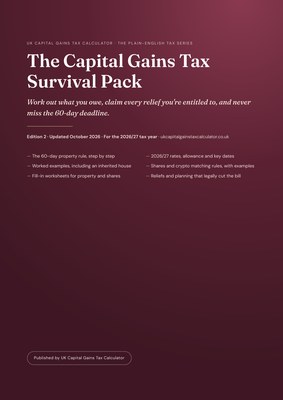
Capital Gains Tax Survival Pack
- The 60-day property deadline, step by step
- Share and crypto matching rules, with worksheets
£4.99 one-off · instant download · full refund via our contact page
Sources & references
The rates, allowances and rules in this guide are drawn from the official HMRC and GOV.UK sources below, checked for the 2026/27 tax year. Each link opens the relevant government page in a new tab.
- Investors' Relief 2026 (HS308) (checked 27 Nov 2026) www.gov.uk/government/publications/investors-relief-2020-hs308/investors-relief-2026-hs308
- HMRC Capital Gains Manual CG63500: Investors' Relief introduction (checked 27 Nov 2026) www.gov.uk/hmrc-internal-manuals/capital-gains-manual/cg63500
- Taxation of Chargeable Gains Act 1992, section 169VC: Investors' relief (checked 27 Nov 2026) www.legislation.gov.uk/ukpga/1992/12/section/169VC
- Taxation of Chargeable Gains Act 1992, section 1I: entrepreneur gains use the basic rate band first www.legislation.gov.uk/ukpga/1992/12/section/1I
- Capital Gains Tax: rates and the £3,000 allowance for 2026 to 2027 (checked 22 Nov 2026) www.gov.uk/capital-gains-tax/rates
- Business Asset Disposal Relief: eligibility www.gov.uk/business-asset-disposal-relief/eligibility